

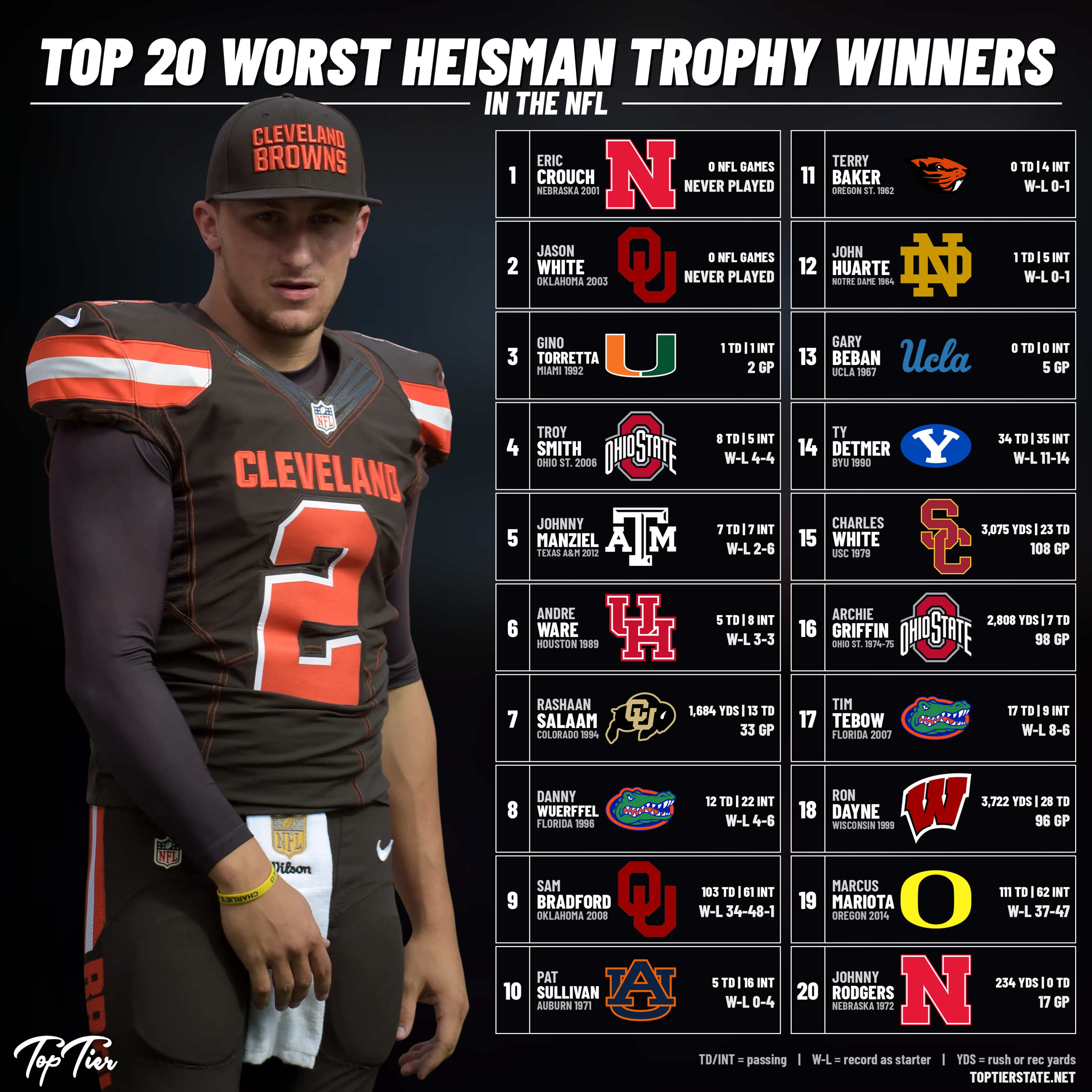
The Heisman Trophy goes to the most outstanding player in college football. It does not come with a scouting report. Plenty of winners became stars on Sundays. These 20 did not.
To be clear, this is not a list of the worst college players to win the award. This is about how their NFL careers measured up to the expectations that came with the stiff-arm statue.
Here is what went into the order:
- NFL production relative to Heisman expectations. A winner who never took a regular-season snap ranks below one who carved out a long backup career.
- Draft capital. A No. 1 or No. 2 overall pick carries a heavier burden than a seventh-rounder.
- Games, starts and record. How often did they play, how often did they start, and did their teams win?
- NFL only. Some of these players found success in the CFL or NFL Europe, and they get credit for it below, but the ranking is based on NFL (and old AFL) numbers.
Career stat lines come from Pro Football Reference. Heisman season numbers come from Sports Reference and Heisman.com. Let's count it down.
20. johnny rodgers, wr, nebraska (1972)
Johnny "The Jet" Rodgers was one of the most electric players of his era. A year before his Heisman, his 72-yard punt return touchdown set the tone in Nebraska's 35-31 win over Oklahoma in the 1971 "Game of the Century." In 1972 he won the Heisman and the Walter Camp Award as a do-everything weapon.
The San Diego Chargers took him 25th overall in 1973, but Rodgers chose the CFL. With the Montreal Alouettes he was the CFL's Most Outstanding Rookie in 1973 and helped win the 1974 Grey Cup. Injuries limited his effectiveness after he joined the Chargers in 1977, and his NFL career ended following the 1978 season.
NFL line: 234 receiving yards, 0 TD in 17 games.
His pro career was a genuine success. It just happened in Canada, which is why he sits at No. 20.
19. marcus mariota, qB, oregon (2014)
Mariota's 2014 season was a monster: 4,454 passing yards, 42 touchdowns and just 4 interceptions, plus 770 rushing yards and 15 more scores. He became Oregon's first Heisman winner and led the Ducks to the first College Football Playoff title game.
Tennessee drafted him second overall in 2015. He started for four seasons and led the Titans to a playoff win in 2017, their first postseason victory since 2003. Injuries and inconsistency followed, and he lost the job to Ryan Tannehill in 2019.
NFL line: 111 TD, 62 INT, 37-47 as a starter.
That is a real career, and it is still going. But No. 2 overall picks are supposed to become franchise quarterbacks, and Mariota never quite did.
18. Ron Dayne, RB, Wisconsin (1999)
Dayne left Madison as the NCAA's career rushing leader. In his Heisman season he ran for 2,034 yards and 20 touchdowns, counting the Rose Bowl.
The New York Giants took him 11th overall in 2000. As a rookie he teamed with Tiki Barber in the "Thunder and Lightning" backfield, and the Giants reached Super Bowl XXXV. After that his carries steadily shrank.
NFL line: 3,722 rushing yards, 28 TD in 96 games.
Fine numbers for a role player. For a top-12 pick and college football's all-time leading rusher, they fell short.
17. Tim Tebow, QB, Florida (2007)
Tebow was the first underclassman to win the Heisman, throwing 32 touchdown passes and running for 23 more. He was the first player in FBS history to pass and rush for 20 or more touchdowns in the same season, and he won two national titles in Gainesville.
Denver drafted him 25th overall in 2010. In 2011 he took over as the starter and produced one of the decade's iconic playoff moments, an 80-yard touchdown pass to Demaryius Thomas on the first play of overtime to beat Pittsburgh. After the Broncos signed Peyton Manning, Tebow was traded to the Jets and spent a year as a backup.
NFL line: 17 TD, 9 INT, 8-6 as a starter.
The winning record and that playoff win keep him out of the top 10. The questions about his passing are why it lasted only three seasons.
16. Archie Griffin, RB, Ohio State (1974 and 1975)
Griffin is the only two-time Heisman winner in history. He ran for 1,620 yards in 1974 and 1,357 in 1975, set an NCAA record with 31 straight 100-yard games, and started four Rose Bowls.
Cincinnati drafted him 24th overall in 1976. He spent all seven NFL seasons with the Bengals and played in Super Bowl XVI. A significant Achilles injury in 1980 cost him speed and the starting job.
NFL line: 2,808 rushing yards, 7 TD in 98 games.
Seven years with one team is no disaster. The gap between "only two-time winner" and 7 career rushing touchdowns is what puts him here.
15. Charles White, RB, USC (1979)
White led the nation in rushing in 1979, finishing with 2,050 yards and 19 touchdowns including the bowl game. He capped it with 247 yards and the winning touchdown in USC's 17-16 Rose Bowl win over Ohio State.
Cleveland drafted him 27th overall in 1980. His four years with the Browns were rough, and White later acknowledged he struggled with cocaine addiction during that time. Released before the 1985 season, he reunited with his college coach, John Robinson, on the Los Angeles Rams. In 1987 he led the NFL in rushing, made the Pro Bowl and was named Comeback Player of the Year.
NFL line: 3,075 rushing yards, 23 TD in 108 games.
That 1987 comeback is a great story and the reason he is not higher. The rest of his career is the reason he is here at all.
14. Ty Detmer, QB, BYU (1990)
Detmer was a record-breaking machine. In 1990 he threw for 5,188 yards and 41 touchdowns and led BYU to a 28-21 upset of top-ranked Miami with 406 passing yards.
Scouts thought he was too small, and Green Bay took him in the ninth round, 230th overall, in 1992. He spent four years behind Brett Favre, then won his first four starts in Philadelphia in 1996. He played 14 seasons for six teams, mostly as a backup.
NFL line: 34 TD, 35 INT, 11-14 as a starter.
Fourteen years is impressive for a ninth-rounder. More interceptions than touchdowns from one of the most prolific passers in college history is why he is here.
13. Gary Beban, QB, UCLA (1967)
Beban led UCLA to a 24-5-2 record over three seasons and won the Heisman and Maxwell in 1967. In the famous 21-20 loss to USC that year, he threw for more than 300 yards while playing through torn rib cartilage.
The Rams drafted him in the second round, 30th overall, in 1968, then traded his rights to Washington when contract talks stalled. There he sat behind future Hall of Famer Sonny Jurgensen and barely played before being released in 1970.
NFL line: 0 TD, 0 INT in 5 games.
He threw one NFL pass. There was simply no path to the field.
12. John Huarte, QB, Notre Dame (1964)
After barely playing his first two seasons, Huarte broke out as a senior under new coach Ara Parseghian, throwing for 2,062 yards and 16 touchdowns as the Irish won all but one game.
He was drafted by both leagues, 12th overall in the AFL and 76th in the NFL, and signed with the AFL's New York Jets. Bad timing: the Jets also signed rookie Joe Namath, who beat him out. Huarte bounced to the Boston Patriots and several other stops.
NFL line: 1 TD, 5 INT, 0-1 as a starter in 24 games.
Sometimes the guy next to you on the depth chart is a future Hall of Famer.
11. Terry Baker, QB, Oregon State (1962)
Baker might be the best all-around athlete on this list. He threw for 1,738 yards and 15 touchdowns in his Heisman season, and his 99-yard run in the Liberty Bowl is an NCAA record that can only be tied. That spring he led Oregon State's basketball team to the Final Four. He is still the only athlete to win the Heisman and play in a Final Four.
The Los Angeles Rams made him the first overall pick in 1963. He spent three seasons in L.A. moving between quarterback, halfback and receiver, then played a season in the CFL with Edmonton.
NFL line: 0 TD, 4 INT, 0-1 as a starter in 18 games.
A No. 1 overall pick who never threw an NFL touchdown pass belongs in the top half.
10. Pat Sullivan, QB, Auburn (1971)
Sullivan was responsible for 72 touchdowns at Auburn, tying the NCAA record. In 1971 he threw for 2,012 yards and 20 touchdowns, edging Cornell's Ed Marinaro for the Heisman.
Atlanta drafted him in the second round, 40th overall, in 1972. He played four seasons with the Falcons and lost all four of his starts. Washington cut him before the 1976 season, and later stops with the Bears and 49ers did not stick.
NFL line: 5 TD, 16 INT, 0-4 as a starter.
Winless as a starter with more than three interceptions per touchdown is a tough line to overcome.
9. Sam Bradford, QB, Oklahoma (2008)
Bradford's 2008 season was absurd: 4,720 yards, 50 touchdowns and 8 interceptions for what was then the highest-scoring offense in college football history.
The St. Louis Rams took him first overall in 2010, and he was Offensive Rookie of the Year after setting a rookie record for completions. Then the injuries came. He tore his left ACL in 2013, tore it again in the 2014 preseason and missed that whole year. He was traded to the Eagles in 2015 and the Vikings in 2016, and retired after 2018.
NFL line: 103 TD, 61 INT, 34-48-1 as a starter.
Bradford is by far the most productive passer in this top 10, and injuries clearly robbed him. But he was the No. 1 overall pick and never started a playoff game.
8. Danny Wuerffel, QB, Florida (1996)
Wuerffel was the perfect trigger man for Steve Spurrier. In 1996 he threw for 3,625 yards and 39 touchdowns, leading the nation in TD passes for the second straight year, and capped it with a 52-20 Sugar Bowl win over Florida State for the national title.
Scouts saw him as a marginal prospect, and New Orleans took him in the fourth round, 99th overall, in 1997. After three years with the Saints, he led the Rhein Fire to the NFL Europe title and was World Bowl MVP in 2000, then had single seasons in Green Bay and Chicago. He reunited with Spurrier in Washington in 2002 and was released before 2003.
NFL line: 12 TD, 22 INT, 4-6 as a starter.
Nearly two picks per touchdown from a quarterback who left college with the best career passing efficiency in major college history at the time.
7. Rashaan Salaam, RB, Colorado (1994)
Salaam ran for 2,055 yards and 24 touchdowns in 1994, becoming just the fourth player ever to top 2,000 rushing yards in a college season. He swept the Heisman, Walter Camp and Doak Walker awards as Colorado went 11-1.
Chicago drafted him 21st overall in 1995, and his rookie year looked promising: 1,074 yards and 10 touchdowns. But he also fumbled 9 times, lost 8 fumbles and averaged 3.6 yards per carry. Injuries, fumbles and marijuana use followed, and he managed only 608 combined yards over his last two years in Chicago.
NFL line: 1,684 rushing yards, 13 TD in 33 games.
His college season earned him a posthumous College Football Hall of Fame induction in 2022. His NFL career was essentially one year long.
6. Andre Ware, QB, Houston (1989)
Ware ran Houston's run-and-shoot to perfection, throwing for 4,699 yards and 46 touchdowns and setting 27 NCAA records. He became the first Black quarterback to win the Heisman.
Detroit drafted him seventh overall in 1990, a pick coach Wayne Fontes made over the advice of the team's scouting director, who resigned the next day. Over four years with the Lions, Ware played 14 games and started 6, usually only once Detroit was out of the race or well behind. Stints with the Vikings, Raiders and Jaguars never produced regular-season action.
NFL line: 5 TD, 8 INT, 3-3 as a starter.
A top-10 pick with five career touchdown passes is about as clear a bust as it gets.
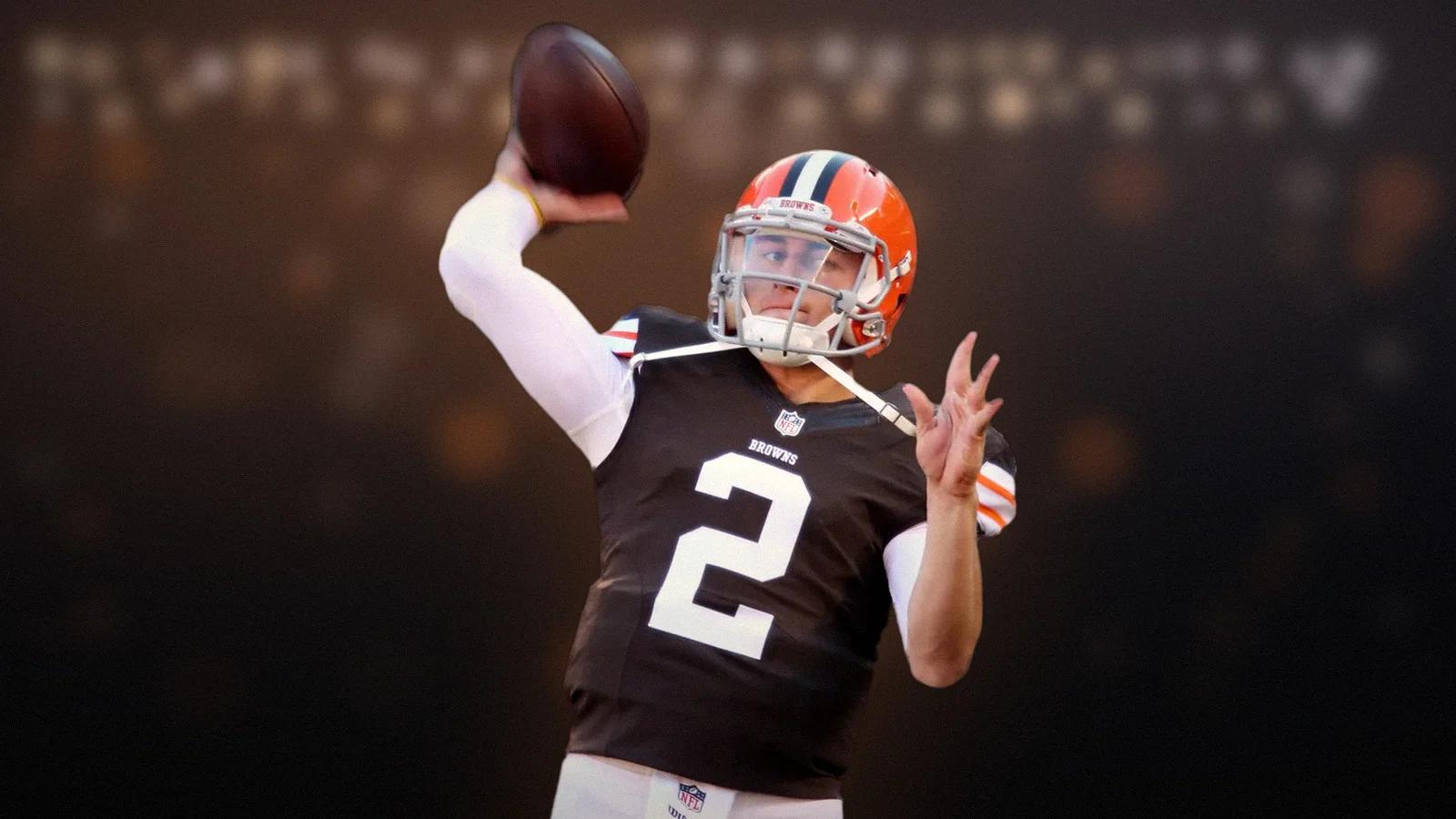
5. Johnny Manziel, QB, Texas A&M (2012)
"Johnny Football" was the first freshman to win the Heisman. He threw for 3,706 yards and 26 touchdowns, ran for 1,410 yards and 21 more, and set an FBS freshman record with 5,116 yards of total offense. In Tuscaloosa he accounted for 345 of A&M's 418 yards in a 29-24 upset of No. 1 Alabama.
Cleveland traded up to draft him 22nd overall in 2014. His first start was a 30-0 loss to Cincinnati. He had flashes in 2015, but his tenure was defined by inconsistent play and off-field issues. The Browns released him in March 2016.
NFL line: 7 TD, 7 INT, 2-6 as a starter.
Two seasons, eight starts and gone. Few winners have had a bigger gap between college hype and NFL output.
4. Troy Smith, QB, Ohio State (2006)
Smith won the 2006 Heisman in a landslide. He threw 30 touchdown passes, went 3-0 as a starter against Michigan, and took 91.6 percent of the first-place votes, a record that stood for 13 years. Then Florida beat Ohio State 41-14 for the national title, and his draft stock sank along with questions about his height.
Baltimore took him in the fifth round, 174th overall, in 2007. He was set to start a 2008 preseason game when he came down with Lemierre's syndrome, a rare illness, and rookie Joe Flacco took the job for good. Smith got his best chance as a starter in San Francisco in 2010 before finishing in the UFL and CFL.
NFL line: 8 TD, 5 INT, 4-4 as a starter.
The numbers are not terrible, and the illness was terrible luck. But eight starts for a runaway Heisman winner earns a top-five spot.
3. Gino Torretta, QB, Miami (1992)
Torretta went 26-2 as Miami's starting quarterback and was part of two national championship teams. He threw for 3,060 yards and 19 touchdowns in 1992 and swept the Heisman, Maxwell, Davey O'Brien and Walter Camp awards.
NFL teams did not see a pro prospect. Minnesota took him in the seventh round, 192nd overall, in 1993, and he moved between the Vikings, Lions, 49ers, Seahawks and Colts, mostly as a backup. In the 1996 season finale he came off the bench for Seattle and threw a touchdown pass to Joey Galloway.
NFL line: 1 TD, 1 INT in 2 games.
He played, which is more than the next two can say. Barely.
2. Jason White, QB, Oklahoma (2003)
White's story is one of real resilience. He tore the ACL in one knee in 2001 and the other in 2002, then came back to throw for 3,846 yards and 40 touchdowns in 2003, running Oklahoma's offense almost entirely out of the shotgun because he could no longer scramble. He won the Heisman in 2003 and the Davey O'Brien Award in both 2003 and 2004.
His knees scared off every team in the 2005 draft. The Tennessee Titans signed him that May, but he retired in August, citing his knees.
NFL line: 0 NFL games. Never played.
This is not about effort or talent. Two reconstructed knees ended his career before it started.
1. Eric Crouch, QB, Nebraska (2001)
Crouch was the engine of Nebraska's option attack. In 2001 he ran for 1,115 yards and 18 touchdowns, passed for 1,510 yards and 7 more, broke off a school-record 95-yard touchdown run against Missouri, and caught a 63-yard touchdown on the famous "Black 41 Flash Reverse" against Oklahoma. He won the closest Heisman vote since 1985 and led the Huskers to the national title game.
NFL teams thought he was too short to play quarterback. The St. Louis Rams drafted him in the third round, 95th overall, in 2002 to play receiver. A leg injury slowed him in camp, and he retired before the season began.
NFL line: 0 NFL games. Never played.
Crouch edges White for the top spot because he was drafted and healthy enough to get a shot, yet never took a regular-season NFL snap. Of every name on this list, his Heisman translated the least.
The Bottom Line
The Heisman rewards one great college season. NFL success depends on things the award never measures: size, scheme fit, health, timing and who else is on the depth chart.
None of that erases what they did in college. Every one of them gave us at least one season worth remembering, which is exactly why the drop-off in the pros is so hard to forget.
Who did we miss, and who is ranked too high? Let us know, and follow @TopTierStateX on X for more college football lists, breakdowns and breaking news.