

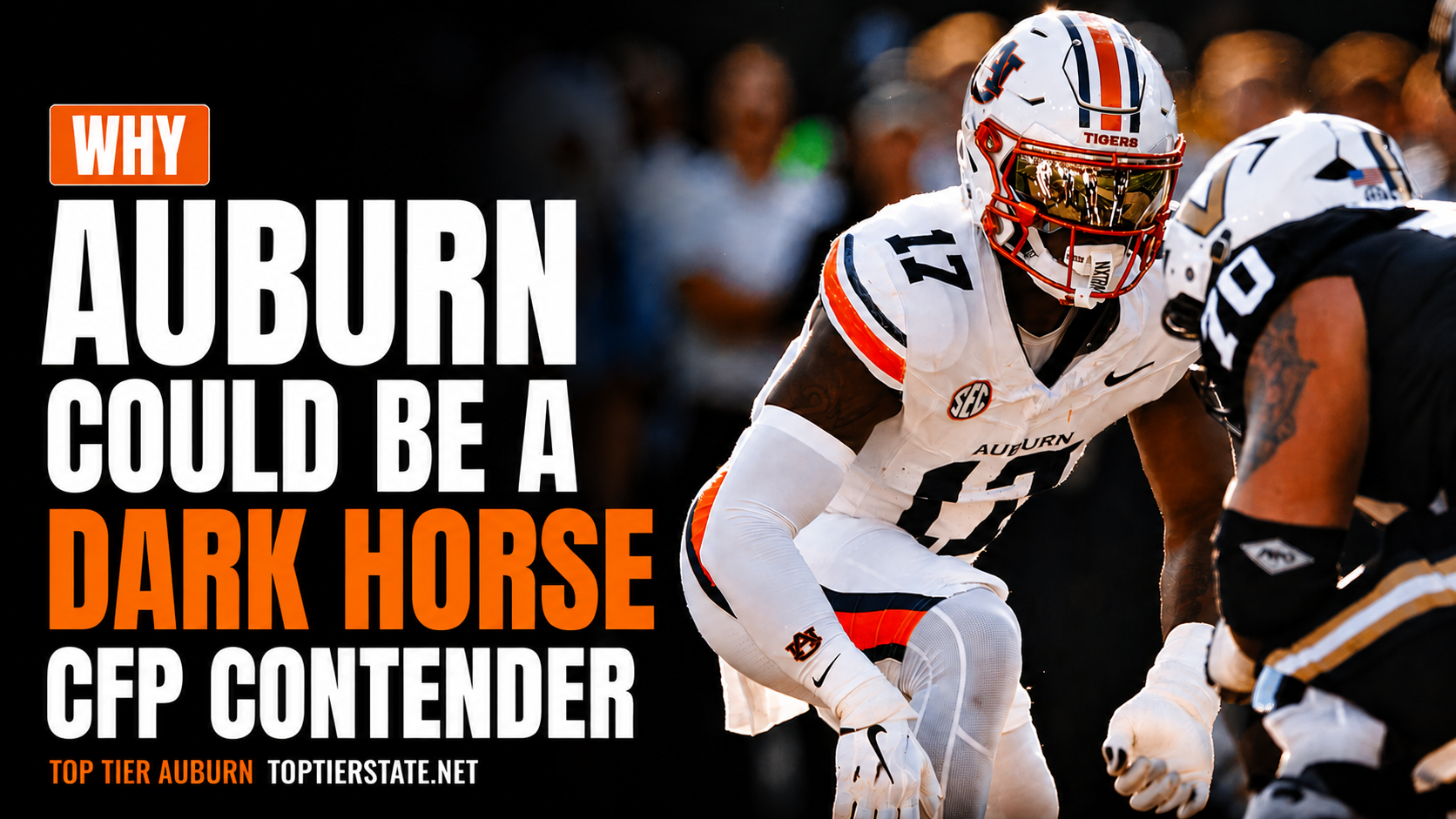
Why Auburn Could Be a Dark-Horse Playoff Contender in 2026
Auburn enters the 2026 college football season in an unfamiliar position but a familiar one as of late.
The Tigers aren’t being discussed as one of the SEC’s favorites. They aren’t receiving the preseason attention of programs such as Texas, Georgia, Alabama or Ole Miss. In fact, SEC media picked Auburn to finish 12th in the league.
That might be exactly what makes Auburn one of the most intriguing dark-horse teams in college football.
There is a realistic path for the Tigers to win 10 games in Alex Golesh’s first season on the Plains. It won’t be easy. Auburn has road trips to Tennessee, Georgia, Ole Miss and Alabama, along with home games against Florida and LSU. But if Golesh can quickly replicate the offensive success he had at USF, Auburn has enough talent, particularly on defense and at running back, to become a legitimate College Football Playoff contender.
I can see Auburn beating Tennessee. I can see Auburn beating Ole Miss. And, yes, I can see Auburn walking into Tuscaloosa and beating Alabama for the first since 2010 (in Tuscaloosa).
If the Tigers can steal a few of those games and take care of the teams they’re supposed to beat, 10-2 isn’t an unrealistic ceiling.
And 10-2 in the SEC puts Auburn directly into the College Football Playoff conversation.
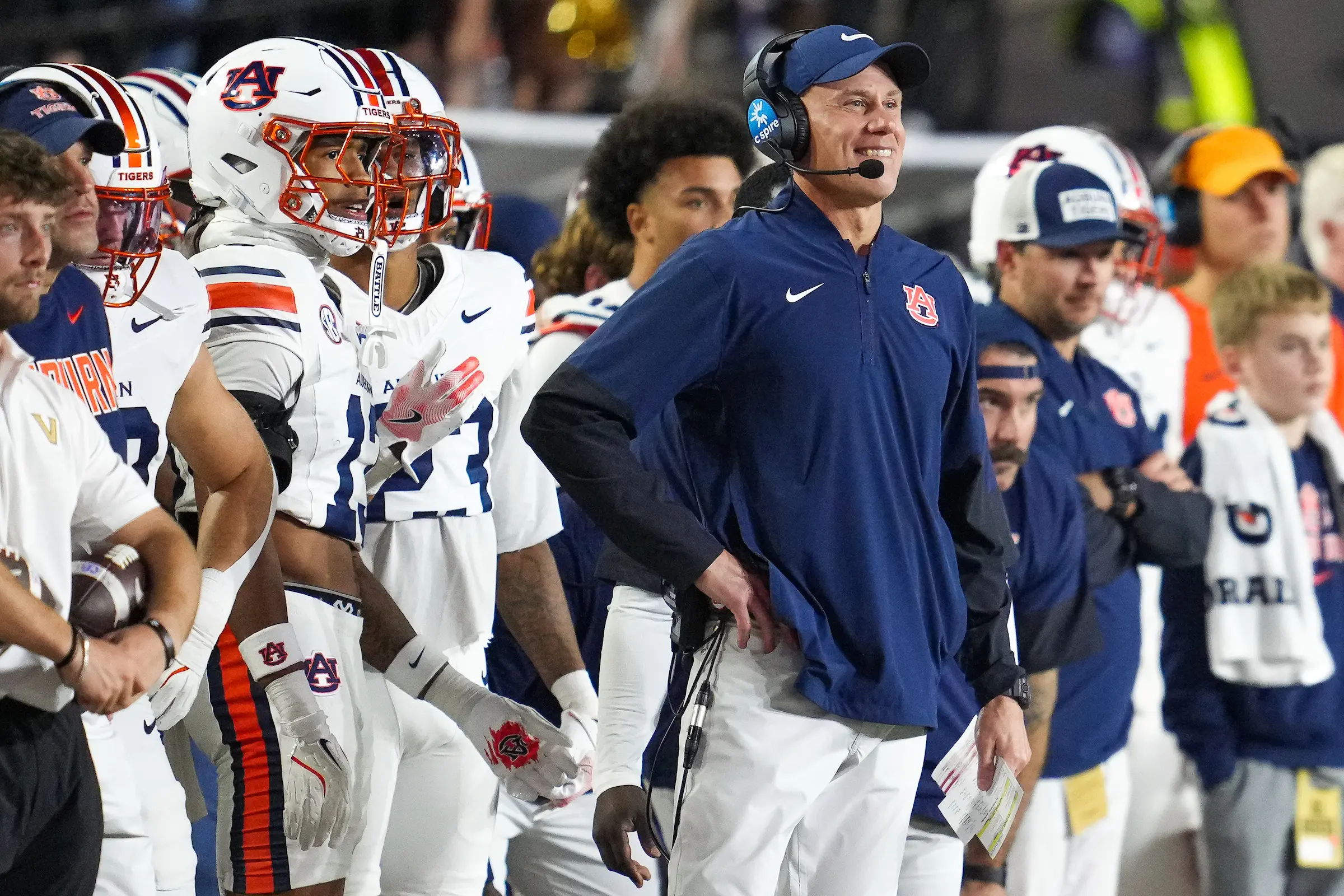
Auburn’s Defense Could Be Among the Nation’s Best
If Auburn surprises the country in 2026, it will likely begin with its defense.
Defensive coordinator DJ Durkin gives Auburn something incredibly valuable entering a coaching transition: continuity on one side of the football.
And Durkin has a legitimate superstar to build around.
Linebacker Xavier Atkins enters the season as one of the best defensive players in college football. After transferring to Auburn, Atkins exploded in 2025 with 84 tackles, 17 tackles for loss and nine sacks. His 17 tackles for loss led the SEC, and he earned second-team All-America and first-team All-SEC honors.
Now he’s receiving preseason All-America recognition and was voted first-team Preseason All-SEC.
Atkins has a chance to become the identity of Auburn’s football team.
He’s disruptive, instinctive and capable of completely changing a possession. In an SEC increasingly dominated by explosive offenses and mobile quarterbacks, having a linebacker capable of making plays behind the line of scrimmage is invaluable.
But Auburn’s defensive potential goes beyond one player.
There is enough returning experience and talent around Atkins for Durkin to build another outstanding unit. Auburn’s defense should be fast, physical and aggressive, and the continuity within Durkin’s system should give the Tigers an advantage early in the season while Golesh rebuilds the offense.
I believe Auburn can have a top-10 defense nationally in 2026.
If that happens, the Tigers aren’t going to need to score 40 points every Saturday.
They’ll need the offense to be good enough.
And that’s where Auburn’s season becomes fascinating.
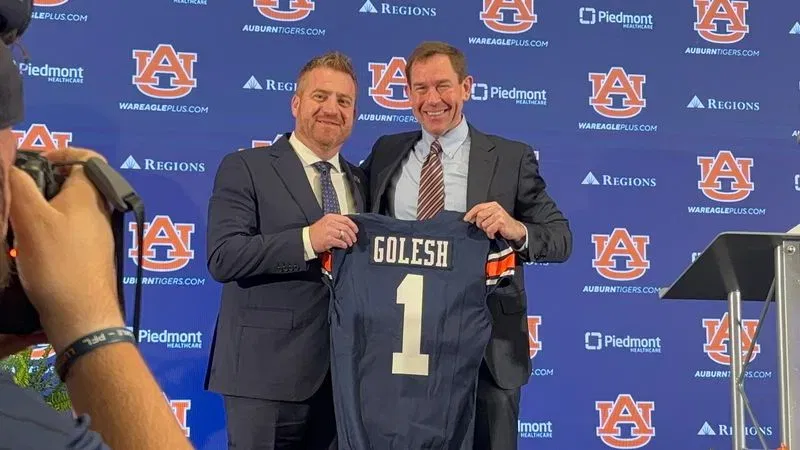
The Biggest Question: Can Golesh’s Offense Work in the SEC?
Alex Golesh didn’t arrive at Auburn alone.
He brought a significant portion of what made his offense successful at South Florida with him.
That starts with quarterback Byrum Brown.
Brown was one of the most productive quarterbacks in college football in 2025, completing 66.3 percent of his passes for 3,158 yards and 28 touchdowns while adding 1,008 rushing yards and 14 touchdowns.
That’s 4,166 yards and 42 touchdowns between passing and rushing.
Brown led all FBS quarterbacks with 42 total touchdowns and averaged 347.2 yards of total offense per game.
Those are video-game numbers.
More importantly, Brown already understands Golesh’s offense.
There shouldn’t be the typical learning curve that comes with a first-year head coach installing a completely new offensive system. Brown has already operated it successfully. He understands the reads, the tempo and the expectations.
And he’s not the only player following Golesh from Tampa to Auburn.
Wide receiver Jeremiah Koger caught 38 passes for 597 yards and eight touchdowns at USF last season.
Christian Neptune added 38 receptions for 335 yards and a touchdown while also contributing as a runner and even throwing a touchdown pass.
Chas Nimrod, who previously played at Tennessee before spending 2025 at USF, had 23 receptions for 466 yards and three touchdowns despite playing only seven games because of injury.
Tight end Jonathan Echols followed Golesh as well after catching nine passes for 109 yards and three touchdowns in 2025.
Then there’s running back Nykahi Davenport.
Davenport could end up becoming one of Auburn’s most important transfers.
He rushed for 612 yards and seven touchdowns on only 98 carries last season, averaging an impressive 6.2 yards per attempt.
Golesh isn’t simply installing his offense at Auburn.
He’s importing players who already know how to run it.
That’s an important distinction.
The question isn’t whether Golesh’s offense can work. We’ve already seen it work.
The question is whether it can work against SEC defenses every week.
That’s a much different challenge.
If the answer is yes, Auburn’s ceiling changes dramatically.
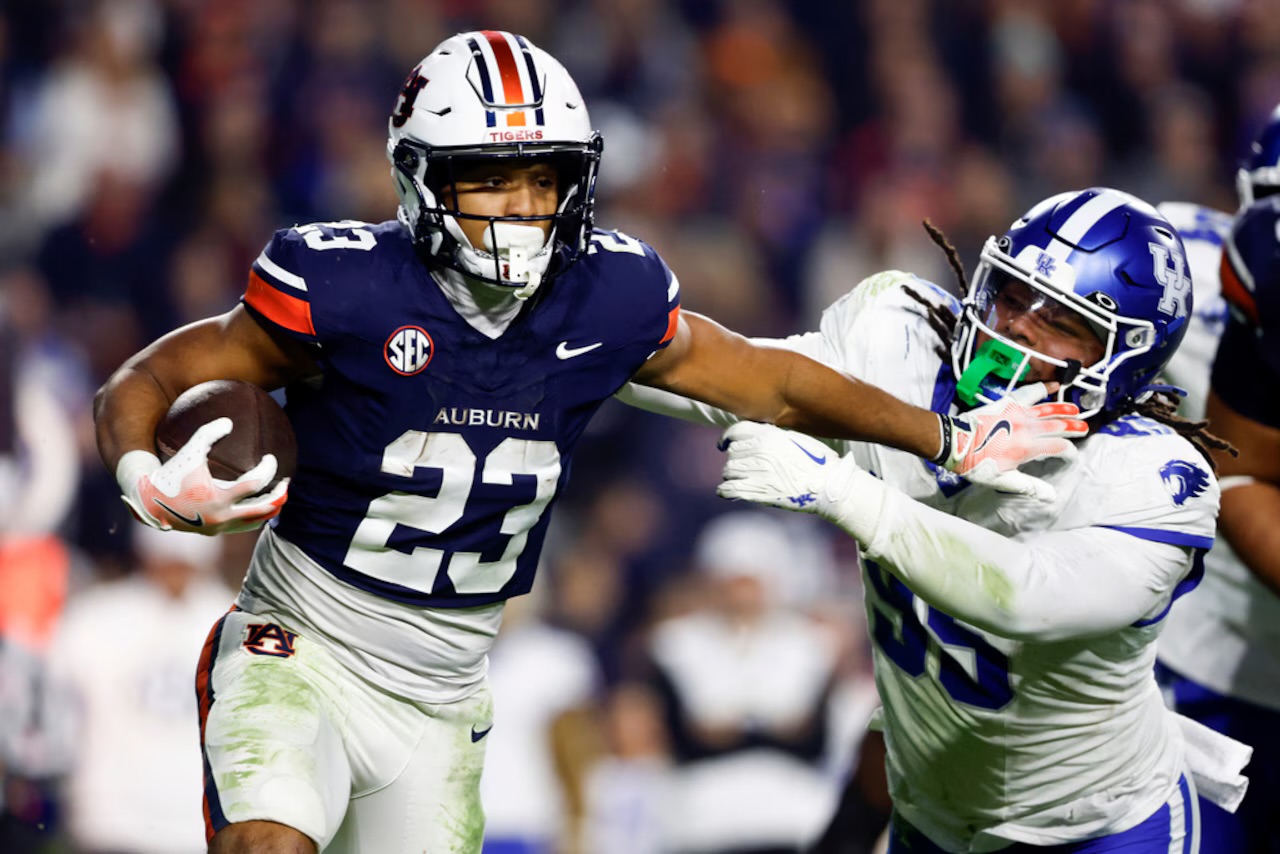
Auburn’s Running Back Room Could Be Special
One position Auburn shouldn’t have to worry about is running back.
The Tigers could quietly have one of the deepest running back rooms in the country.
Everything starts with Jeremiah Cobb.
Cobb finished 2025 with 969 rushing yards on 175 carries, averaging 5.5 yards per attempt and scoring five touchdowns.
He finished just 31 yards short of 1,000.
If Cobb stays healthy, I expect that drought to end quickly in 2026.
He’s talented enough to become a 1,000-yard SEC running back and should benefit from playing in an offense that creates opportunities for explosive runs.
But what makes Auburn’s backfield especially dangerous is what sits behind him.
Golesh and his staff added Bryson Washington from Baylor, Davenport from USF and Tae Meadows from Troy.
Washington is already a proven Power Four running back. He rushed for 788 yards and six touchdowns for Baylor in 2025 after producing 1,028 yards and 12 touchdowns as a freshman in 2024.
Davenport brings another dimension after averaging 6.2 yards per carry at USF.
And Meadows rushed for 695 yards and six touchdowns at Troy last season, including a 186-yard performance against Nicholls.
Think about that depth.
Jeremiah Cobb: 969 rushing yards in 2025.
Bryson Washington: 788 rushing yards.
Tae Meadows: 695 rushing yards.
Nykahi Davenport: 612 rushing yards.
That’s four running backs who produced at least 600 rushing yards last season.
And that doesn’t even include Brown, who rushed for 1,008 yards himself.
Golesh is going to have options.
Cobb should enter the season as RB1, but Washington, Davenport and Meadows will battle for the RB2 and RB3 roles. More importantly, Auburn won’t have to run Cobb into the ground.
In a nine-game SEC schedule, that depth matters.
By November, when other teams are dealing with injuries and exhausted running backs, Auburn could still have multiple legitimate options.
Byrum Brown Could Be the Difference
Ultimately, Auburn’s playoff chances may come down to Brown.
Auburn hasn’t lacked talent in recent years. What the Tigers have lacked is consistent quarterback production.
Brown gives Golesh something Auburn hasn’t had in a while: a proven quarterback entering the season with a clear understanding of the offensive system.
And his running ability creates another problem entirely.
Defenses can’t simply load the box to stop Cobb.
If linebackers crash toward the running back, Brown can keep the football and punish them.
If safeties creep toward the line of scrimmage, Golesh can attack vertically.
That puts enormous stress on a defense.
Brown doesn’t need to duplicate his 3,158 passing yards and 1,008 rushing yards from last season for Auburn to succeed. If he can simply remain efficient, protect the football and consistently create explosive plays, Auburn’s offense should improve dramatically.
But if Brown does approach his 2025 production?
Auburn could become one of the most dangerous teams in the SEC.
The Schedule Is Difficult — But There’s a Path to 10-2
Nobody should look at Auburn’s schedule and call it easy.
The Tigers open against Baylor in Atlanta before playing Southern Miss, Florida and Vanderbilt at Jordan-Hare Stadium.
Then the difficulty increases.
Auburn travels to Tennessee before an open date and a trip to Georgia. LSU comes to Jordan-Hare the following week, followed by a trip to Ole Miss.
The Tigers finish with Arkansas, Mississippi State and Samford before traveling to Tuscaloosa for the Iron Bowl.
That’s a brutal schedule.
But look closer and there is a path.
What if Auburn starts 4-0?
What if the Tigers then beat Tennessee?
Suddenly Auburn is 5-0 heading into Athens with national attention beginning to build.
Even if Auburn loses to Georgia, the season isn’t over. Beat LSU at home, split the Ole Miss and Alabama road games and avoid an upset against Arkansas or Mississippi State, and Auburn could find itself sitting at nine or 10 victories.
That’s why games at Tennessee, Ole Miss and Alabama are so important.
Auburn doesn’t have to win all three.
But I believe Auburn is capable of winning all three.
Get two of them, protect Jordan-Hare Stadium and avoid the type of inexplicable loss that has plagued Auburn in recent seasons, and the math starts becoming interesting.
A 10-2 SEC team with Auburn’s schedule would have a compelling playoff résumé.
Can Golesh Bring a Winning Mentality Back to Auburn?
This might be the biggest question surrounding Auburn entering 2026.
Not talent.
Not scheme.
Belief.
Auburn football has spent the last several seasons searching for stability and an identity.
Golesh appears to bring a different mentality.
He’s aggressive. He’s confident. And instead of slowly rebuilding the roster over several recruiting cycles, he attacked the transfer portal immediately. Auburn officially added 39 transfers, completely reshaping the roster for Year 1.
There is obvious risk involved.
You can’t replace that many players and simply assume everything will work immediately.
But there is also upside.
Golesh isn’t asking Auburn to wait three years.
He’s trying to win now.
The presence of Brown and numerous former USF players could accelerate the transition because some of Auburn’s most important offensive players already understand exactly what their head coach expects.
The talent is there.
The defense should be good enough.
The running game should be one of Auburn’s strengths.
The quarterback has already proven he can produce at an elite level in Golesh’s system.
Now we find out whether it translates to Saturdays in the SEC.
Don’t Sleep on Auburn
Calling Auburn a College Football Playoff contender right now will probably sound crazy to some people.
That’s why it’s a dark-horse pick.
Nobody is saying Auburn should be favored to win the SEC. Nobody is saying the Tigers are suddenly better than Georgia, Texas or every other contender in the conference.
But college football seasons rarely unfold exactly as expected.
Every year, a team emerges that the national conversation overlooked during the offseason.
Auburn has many of the ingredients required to become that team in 2026.
An elite defense.
One of the SEC’s best linebackers.
A dynamic veteran quarterback.
One of the deepest running back rooms in college football.
An offensive head coach bringing a system, and many of the players who already succeeded in it, to the SEC.
And perhaps most importantly, almost no national expectations.
Auburn was picked 12th in the SEC.
Don’t be shocked if the Tigers are playing meaningful football in late November with something much bigger at stake.
Because if Golesh’s offense translates, Brown continues producing and Durkin’s defense becomes the top-10 unit it has the talent to be, Auburn isn’t merely capable of improving.
The Tigers are capable of going 10-2.
And if Auburn gets to 10-2 against this schedule, the Tigers won’t be a dark horse anymore.
They’ll be a College Football Playoff team.