

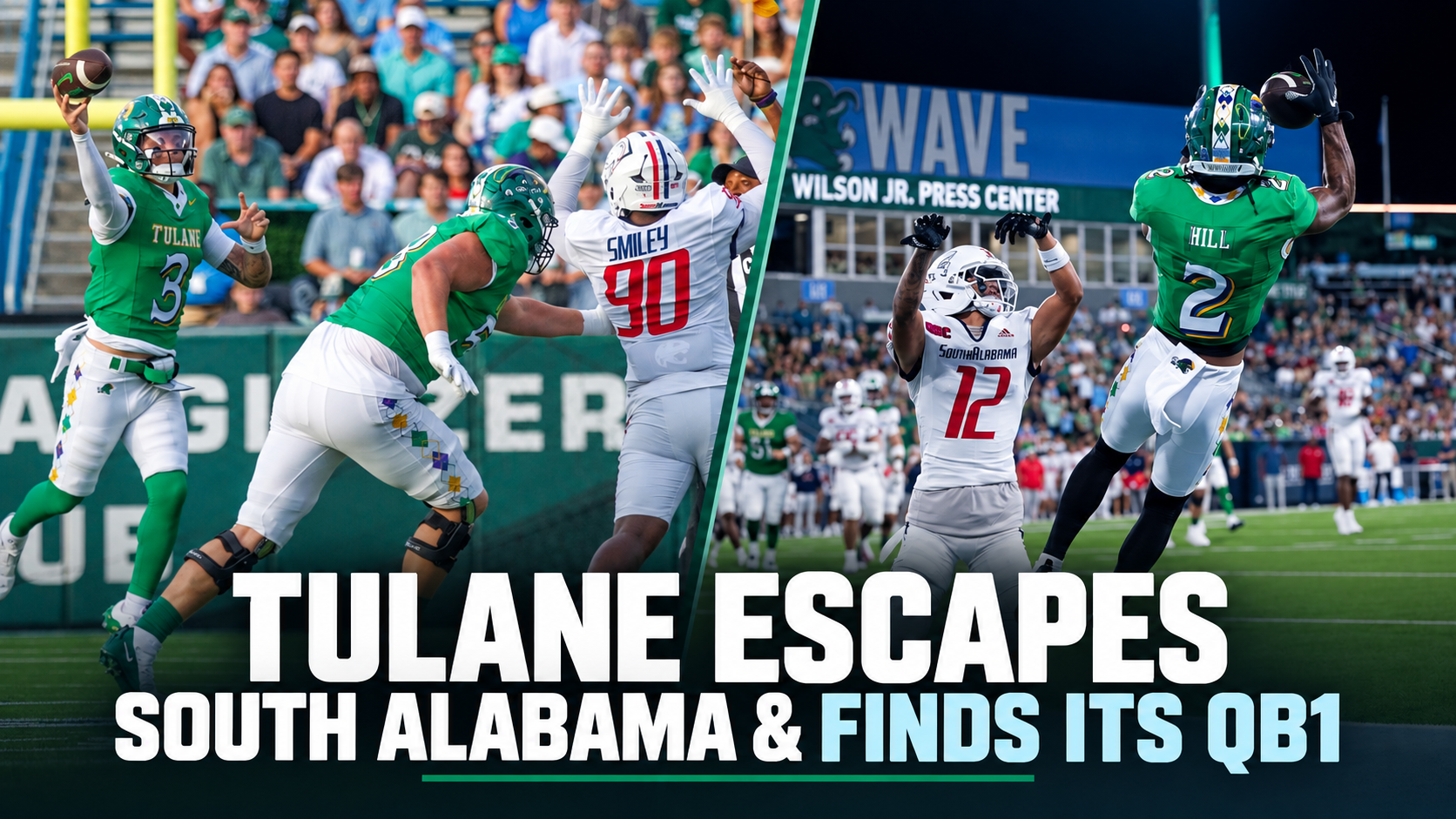
Tulane Found Its QB1 — But the South Alabama Win Exposed Plenty to Fix
Tulane needed a win against South Alabama.
What it got may have been even more important.
The Green Wave walked out of Yulman Stadium with a 28-24 victory Saturday night, but this was hardly the type of performance that suddenly erases every concern from the season-opening loss to Duke. South Alabama controlled large portions of the game, consistently found holes in Tulane’s defense, won the time-of-possession battle by more than 15 minutes and had a chance to put the Green Wave away late.
Instead, Tulane found a way.
And along the way, the Green Wave may have found their quarterback.
Kadin Semonza delivered exactly the type of performance Tulane needed from its new starter, Jaylin Lucas provided the explosive element this offense was missing a week ago, and the Green Wave responded to multiple moments of adversity with enough big plays to escape with their first win of the Will Hall era.
It was imperfect. At times, especially defensively, it was downright concerning.
But after the opener at Duke, Tulane desperately needed something to build around.
Saturday provided it.
Kadin Semonza Looked Like QB1
Forget the raw passing total for a moment.
Semonza finished 14-of-22 for 212 yards, one touchdown and no interceptions. Those numbers are solid, but they don't fully capture what made his performance encouraging.
It was how he played quarterback.
Semonza looked comfortable operating the offense, manipulated the pocket when protection broke down, consistently kept his eyes downfield and, perhaps most importantly, never looked overwhelmed when Tulane fell behind.
That was apparent early.
On Tulane's second possession, South Alabama generated pressure on third-and-five, but Semonza stepped forward in the pocket and found Destyn Hill crossing the field for a first down. Later in the first quarter, with Tulane trailing 10-0 and desperately needing an offensive spark, he delivered one.
Semonza shifted inside the pocket and dropped a beautiful deep ball to Hill for 61 yards, placing it perfectly over the secondary and setting Tulane up at the three-yard line. Johnnie Daniels punched it in shortly afterward to cut the deficit to three.
The throw was an early indication that Semonza could provide something Tulane badly needed: vertical accuracy.
But the defining moment came much later.
Tulane got the football back at its own 22 with 4:39 remaining, trailing 24-21.
This was the moment when a quarterback earns the job.
Semonza converted a massive third-and-one by recognizing South Alabama's zone coverage and finding Garrett Mmahat. Then came perhaps his best throw of the night: a 36-yard wheel route to his brother, Cash Semonza, dropped into a narrow window where only his receiver had a realistic chance to make the play.
Three plays later, Tulane faced third-and-four.
Game potentially on the line.
Semonza faked the handoff to Lucas, kept the football and gave Destyn Hill a chance on a fade toward the end zone.
Hill made the catch.
Touchdown.
Tulane 28, South Alabama 24.
Semonza went 3-for-3 for 63 yards on that final possession. According to postgame reporting, the touchdown was originally an RPO on which Semonza had the option to hand the ball off. Instead, he decided to keep it and attack the matchup himself.
That's the play of a quarterback who wants the game in his hands.
After spending the offseason and preseason searching for its answer at quarterback, Tulane appears to have one.
Will Hall praised Semonza's poise afterward, noting that the quarterback made critical conversion plays when Tulane needed them most.
Saturday wasn't a Heisman-stat-line performance.
It was more important than that.
It looked like the emergence of a leader.
Jaylin Lucas Changed the Entire Offense
Then there was Jaylin Lucas.
Eleven carries.
214 yards.
One touchdown.
19.5 yards per carry.
It wasn't simply an excellent rushing performance. Lucas became the first player to rush for more than 200 yards in a game at Yulman Stadium, and his 214 yards were the most by a Tulane player since Tyjae Spears rushed for 264 against Memphis in 2021.
What stood out watching the game was where the production came from.
Tulane's conventional inside run game struggled for much of the night. Maurice Turner was repeatedly met at or behind the line of scrimmage. Daniels was extremely valuable in short yardage, scoring twice, but finished with just eight yards on six carries.
Lucas was different.
When Tulane got him outside the tackles and into space, South Alabama had almost no answer.
He broke a 32-yard outside run in the first quarter. Later, backed up near Tulane's own end zone, Lucas followed a key block from Daniels and ripped off another explosive run of more than 50 yards. That possession eventually ended with Daniels powering into the end zone for his second touchdown and giving Tulane a 14-10 halftime advantage.
Then came the biggest one.
Tulane trailed 17-14 late in the third quarter and had just watched its previous possession implode following consecutive false starts.
On second-and-10, Lucas took an outside-zone handoff, found the crease, broke through the first level and accelerated.
Nobody was catching him.
Eighty yards.
Touchdown.
Tulane went from trailing to leading in a matter of seconds.
Hall credited the offensive line and tight ends afterward for creating space for Lucas, while specifically mentioning Daniels' blocking. It was a major improvement from a unit that took considerable criticism following the Duke loss.
There are still issues to solve up front, particularly with the interior run game.
But Tulane learned something Saturday:
If Lucas has space, the offense has a home-run hitter.
Finding creative ways to get him to the perimeter needs to remain a major part of the offensive identity.
The Defensive Box Score Is Hard to Ignore
This is where the celebration needs to be tempered.
Tulane won the game.
South Alabama controlled it.
The Jaguars finished with 478 total yards, 25 first downs and 72 offensive plays. Tulane ran only 51 plays and recorded 13 first downs.
South Alabama held the football for 37:40 compared to Tulane's 22:20 and converted an alarming 10-of-16 third downs.
Those numbers match what showed up repeatedly on the field.
Tulane's secondary spent significant portions of the game playing with large cushions, frequently leaving easy throws underneath. Davenport repeatedly found hitches, outs, digs, crossing routes and checkdowns in holes in the coverage.
There appeared to be relatively little disguise. Too often, Davenport could identify the structure before the snap, find the open area and deliver the football.
He finished 22-of-32 for a career-high 296 yards, two touchdowns and no interceptions while adding another 50 yards rushing.
South Alabama receiver Brendan Jenkins was particularly effective, catching nine passes for 119 yards and a touchdown. Anthony Eager added the Jaguars' biggest passing play, beating the Tulane secondary for a 43-yard touchdown early in the third quarter.
The frustrating part was that many of the completions weren't extraordinary plays.
They were available throws.
Tulane frequently lined up seven to ten yards off the football, South Alabama attacked the cushion, and Davenport methodically moved the chains.
When Tulane did become more aggressive — press coverage, tighter alignments, additional pressure — the defense often looked better.
That contrast was noticeable.
Tackling Remains a Major Problem
Coverage wasn't Tulane's only defensive issue.
The tackling needs to improve immediately.
South Alabama rushed for 182 yards on 40 carries. The 4.6-yard average isn't catastrophic on its own, but the manner in which many of those yards were gained was troubling.
Too many two-yard runs became five-yard runs.
Too many defenders reached the ball carrier without finishing the play.
South Alabama backs consistently fell forward or dragged defenders for extra yardage. Davenport escaped what should have been sacks and turned them into positive plays. On multiple occasions, Tulane had an opportunity to end a drive only to allow additional yards after contact.
Hall acknowledged the problem after the game, saying Tulane has to tackle better.
He's right.
Because against better offenses, those mistakes will become touchdowns.
There were bright spots. Makai Williams finished with eight tackles and two tackles for loss. Reshad Sterling registered 1.5 tackles for loss, and Jack Tchienchou made several important plays near the line of scrimmage. Dickson Agu led Tulane with 14 tackles while Kevin Adams III added 10.
And when the game reached its biggest moments, the defense did make stops.
That matters.
Tulane Survived the Moment That Could Have Broken It
Perhaps the most important sequence of the night came midway through the fourth quarter.
With South Alabama leading 24-21 and trying to drain the clock, Tulane appeared to finally get the breakthrough it needed.
Davenport escaped pressure on third-and-nine and scrambled for the first down before the football came loose. Tulane recovered and returned it for what initially appeared to be the go-ahead touchdown.
Then came the review.
Officials ruled Davenport had initiated his slide before losing possession.
No fumble.
No touchdown.
South Alabama ball.
It was an extremely consequential — and highly questionable — reversal.
Tulane could have unraveled.
Instead, the defense responded.
Sterling helped stuff a run for a loss. On the next play, Tulane finally finished the pressure and dropped Davenport for a major sack. A false start followed, and South Alabama eventually punted on fourth-and-long.
That sequence changed the game.
The defense had just watched an apparent defensive touchdown disappear and still found a way to get off the field.
Then Semonza took over.
An Ugly Win Can Still Tell You Something
The final statistics tell a strange story.
South Alabama had more yards.
More plays.
Nearly twice as many first downs.
More than 15 additional minutes of possession.
A 62.5 percent conversion rate on third down.
Zero turnovers.
And lost.
Tulane survived because its offense was dramatically more explosive, averaging 8.3 yards per play compared to South Alabama's 6.6. The Green Wave also converted all three of their red-zone trips into touchdowns.
That formula probably isn't sustainable every week.
Tulane cannot continually surrender 25 first downs, allow opponents to convert more than 60 percent of their third downs and expect Lucas to average nearly 20 yards every time he touches the football.
But Saturday didn't need to prove that Tulane had solved everything.
It needed to show progress.
The offensive line was better.
Lucas looked dynamic.
Destyn Hill emerged as Semonza's top big-play target, finishing with four catches for 91 yards and the game-winning touchdown.
And most importantly, Semonza looked like a quarterback capable of winning games for Tulane rather than simply managing them.
That might be the biggest development of all.
There is still plenty for Will Hall and his staff to fix. The defensive scheme needs answers. The tackling must improve. The interior run game remains inconsistent. The kicking game remains a concern after another missed field goal.
But when Tulane needed a quarterback to make a play with the game on the line, Semonza delivered.
When Tulane needed an explosive play, Lucas delivered.
And when the Green Wave needed one final stop, the defense delivered.
It wasn't pretty.
It wasn't dominant.
But Tulane is 1-1.
And for the first time this season, it feels like the Green Wave may know who they are building around.
Photo Sources:
Kadin Semonza (NOLA.com)
Destyn Hill (tulanegreenwave.com)