

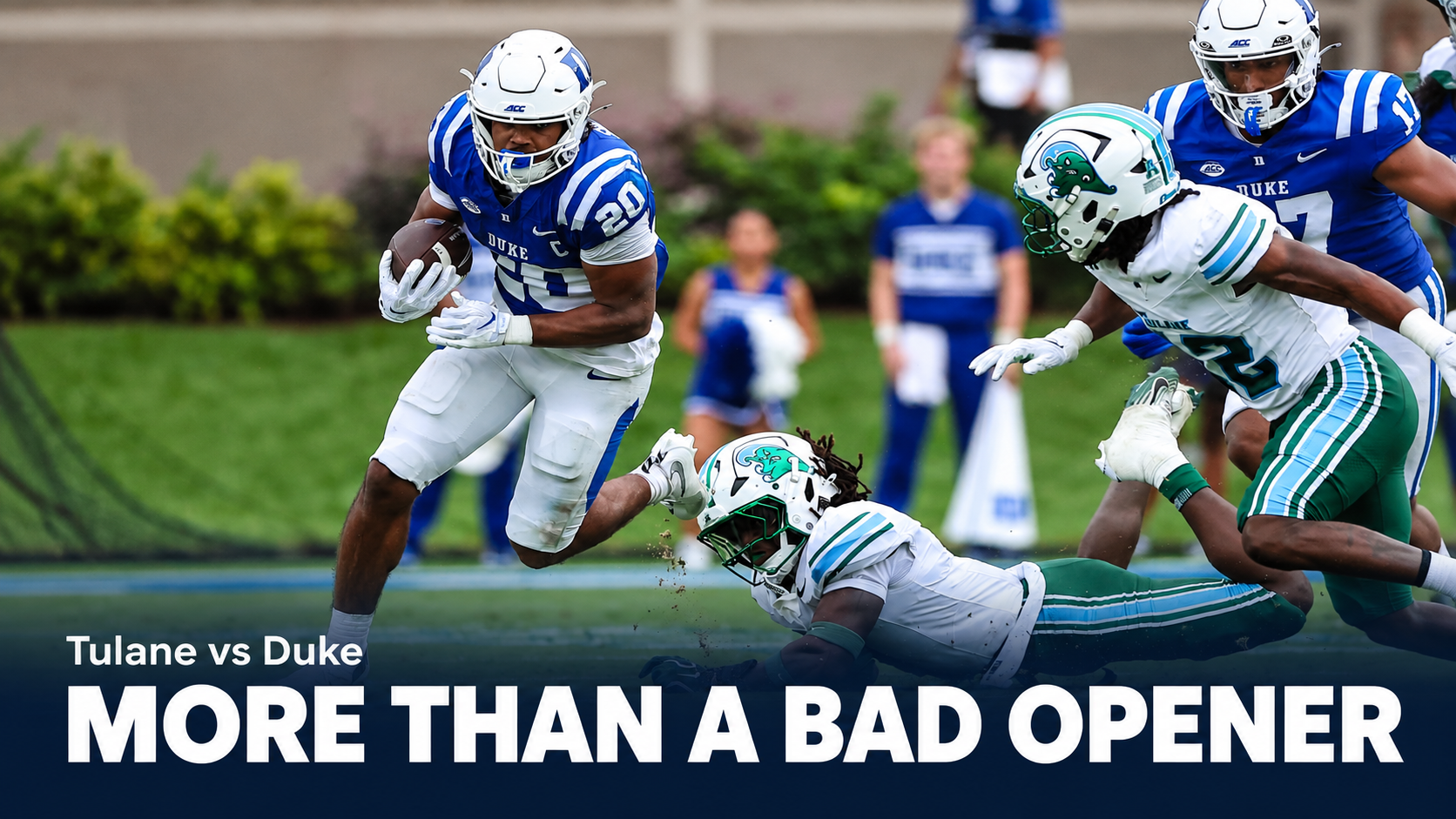
Losing at Duke was not, by itself, a reason to panic. The way Tulane lost was a reason to be concerned.
The Green Wave opened the Will Hall era with a 17-3 defeat
Saturday in Durham, producing an afternoon that felt more frustrating than the
final margin suggests. Tulane remained close enough to make a game of it, but
rarely looked capable of getting out of its own way. Tulane on SI
There were quarterback questions and schematic concerns.
There were defensive stretches worth building on. But the biggest takeaway was
simpler: Tulane made winning considerably harder through mistakes it should be
able to control.
The penalties were the biggest problem
Fifteen accepted penalties for 104 yards. That number
deserves to lead the conversation.
Explosive gains disappeared, manageable situations became
obvious passing downs, and an offense struggling to establish rhythm kept
having to start over. Doug Joubert's postgame breakdown for Tulane on SI
highlighted both a Maurice Turner gain erased by a chop block and a 25-yard run
wiped out by holding. Tulane on SI
For longtime Tulane fans, the repeated self-inflicted
setbacks brought back unwelcome memories of the Bob Toledo and Curtis Johnson
years. That is not a prediction about Hall's tenure. It is a description of how
unfamiliar this level of disorganization should feel for a program with
Tulane's recent expectations.
There is a difference between getting beaten on a snap and
making the next snap unnecessarily difficult. On Saturday, Tulane did too much
of both.
An offense still finding its footing cannot afford to keep
surrendering the progress it does make.
Chriss-Gremillion's skill set needed more help
Zeon Chriss-Gremillion showed flashes of the athleticism
that makes him intriguing. The concern was how little that athleticism seemed
to complicate Duke's defensive job.
Too often, the offense appeared narrowed to short screens
and quarterback runs. Those calls can be useful, but on third down they became
particularly frustrating when Tulane needed an answer beyond the initial
action.
If Chriss-Gremillion is taking snaps, the approach should
lean into run-pass options and play-action opportunities that make defenders
hesitate. His legs should help create throwing windows, not simply become the
fallback whenever the offense needs a play.
The third-and-four quarterback power call was a good example
of the question. Could a version of that concept with a quick slant, hitch or
pop route from an inside receiver have given him a better answer against a
defense attacking the run?
That is a proposed adjustment, not a claim about what
options were built into the actual call. But it gets at the larger issue:
Tulane needed to put Duke in conflict more often.
Chriss-Gremillion also appeared hesitant when the initial reads
were covered. On some unsuccessful screen looks, the running back appeared
available in the flat. Without knowing the actual plays, it appeared to be a
lack of reading through progressions. The offense needed quicker answers when
its first option disappeared.
Semonza gave the offense a better chance
The offense looked more fluid with Kadin Semonza in the
second half. His opening possession offered an immediate glimpse of that before
Destyn Hill fumbled following a 39-yard reception. As Maddy Hudak reported for
Tulane Roundtable, Tulane generated 98 yards before halftime and 160 afterward.
Tulane Roundtable
Semonza also showed enough movement to challenge the idea
that this choice is simply an athlete versus a stationary pocket passer. He
could move around while giving the passing game a more functional rhythm.
That does not mean everything was fixed. The penalties
continued, protection remained unreliable, and the offense still struggled to
finish. But based on Saturday's performance, Semonza gave Tulane the stronger
platform to build from.
Hall has since made that direction official: Semonza will
start against South Alabama per reports.
The next step is giving him an offense that does not
repeatedly undo its own work.
Protection was a unit-wide failure
Tulane's pass protection problems were not limited to the
five offensive linemen. The backs and tight ends also appeared to struggle when
asked to help, leaving too many situations in which the quarterback had little
opportunity to execute.
The late third-and-12 sack, with a Duke defender coming
through untouched, was one of the clearest examples. Whether that breakdown
belonged to an individual assignment or the protection call requires
information beyond the broadcast view. The result was unmistakable: Tulane did
not give the play a chance.
The PFF numbers reinforced that impression. Joubert's review
reported a 26.1 pass-blocking grade for the Green Wave. Tulane on SI's PFF review
A quarterback change cannot solve an untouched rusher.
Neither can a more creative playbook. Protection has to become dependable
enough for either to matter.
The defense competed, but the tackling was unacceptable
Tulane's defense deserves credit for keeping the game within
reach. It also deserves scrutiny for how difficult it made that task.
Nate Sheppard finished with 227 rushing yards and two
touchdowns on 35 carries. Duke led only 10-0 entering the fourth quarter, but
Tulane did not record a sack or a tackle for loss. Tulane Roundtable
The most troubling part was the tackling. Too many attempts
looked like contact without a secure wrap, allowing a dangerous runner to keep
moving. Nate Sheppard recorded an FBS-high 21 missed tackles forced on the day.
PFF's reported 29.9 tackling grade put a number on a problem that was already
obvious. Tulane on SI's PFF review
Third-and-long situations were another frustration. Getting
Duke behind schedule only helped if Tulane finished the possession. Backs
appearing uncovered on checkdowns gave the Blue Devils an escape route when the
defense needed to close one off.
There were encouraging stretches after halftime. The front
appeared to create some hurried throws, and the defensive backs generally
competed well. But some of those passing-game results also benefited from
misses by Walker Eget. Tulane should recognize the progress without assuming
every incompletion meant the coverage or rush had won.
One individual worth highlighting was Warren Roberts Jr. His
reported 89.2 overall defensive grade came across 23 snaps—a promising
performance, even within a limited workload. Tulane on SI's PFF review
The response has to start with the basics
South Alabama will offer Tulane a chance to respond. The
evaluation should extend beyond whether the Green Wave wins.
Does the offense stay on schedule? Do the protection
responsibilities look clear? Are defenders wrapping up and finishing? Does
third-and-long become an opportunity to leave the field instead of another
source of frustration?
Semonza's second-half performance supplied a starting point,
and he will take the lead when the offense steps on the field Saturday. The
defense's persistence supplied another positive point. Neither erases what
happened in Durham.
One game is too early to define this team. But it is not too
early to demand cleaner football.
Tulane does not need to solve its entire season in a week.
It does need to stop making the next snap harder than it has to be.