
How Tulane’s “King of Mardi Gras” City Edition became a viral brand moment—and an immediate NIL windfall

Tulane’s second City Edition release drew an
overwhelmingly positive response across college football and national media.
Image supplied by the user; original creative by Tulane Athletics.
Tulane Football did not merely unveil an alternate uniform on August 12. It launched a cultural statement, a national marketing campaign and a direct fundraising mechanism—all in the same scroll-stopping package.
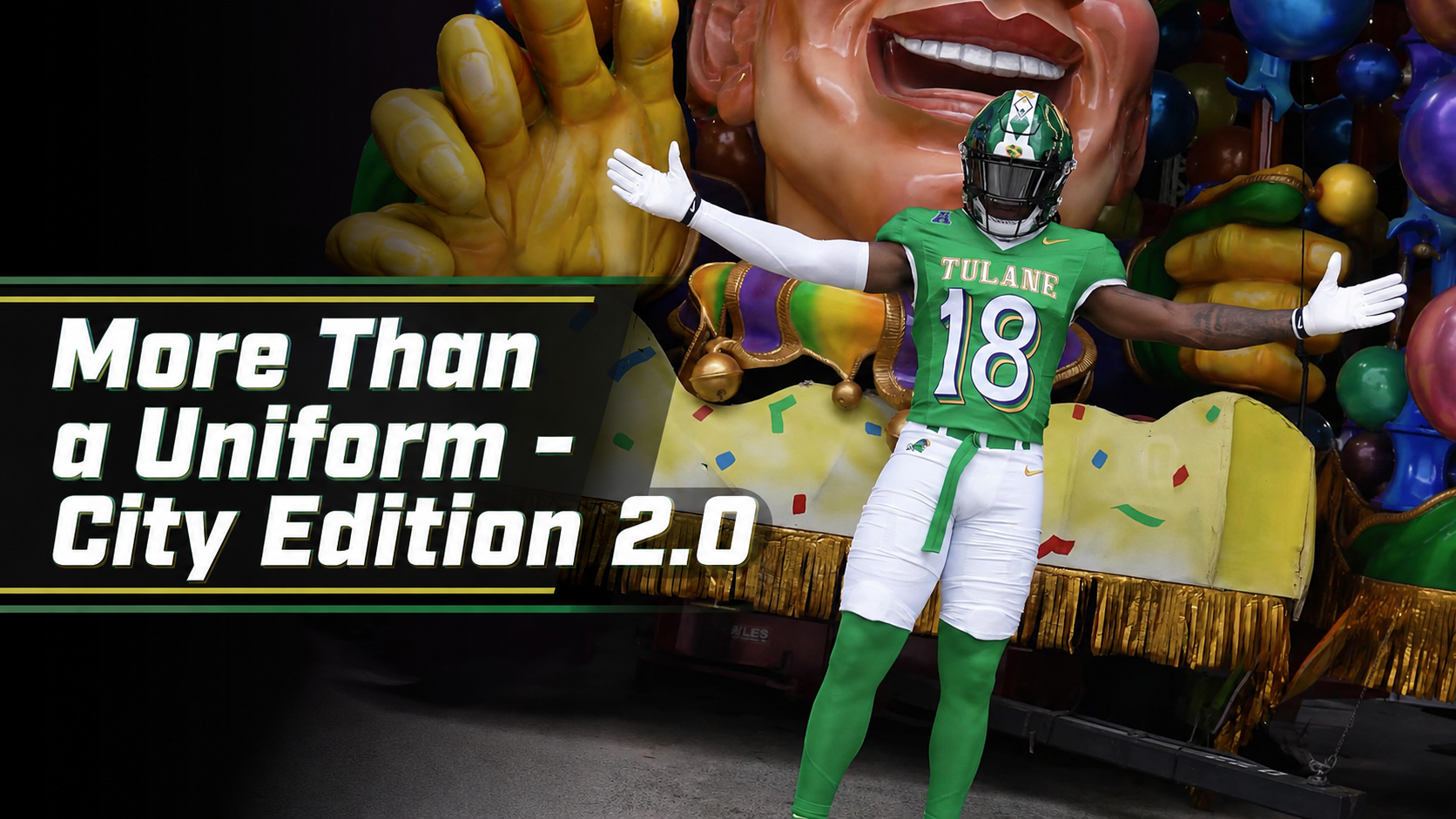
The Green Wave’s 2026 City Edition, dubbed “The King of
Mardi Gras,” was built to celebrate New Orleans and designed to be worn once:
during the September 12 home opener against South Alabama. Within hours of the
reveal, however, the uniform had already accomplished something far bigger than
creating anticipation for one game. It had carried Tulane into national
conversations, converted attention into six-figure support for student-athletes
and reinforced the university’s position as one of college football’s sharpest
storytellers.
The best alternate uniforms do more than look different.
They make a place recognizable, and Tulane has already made a statement in recent years with what some say are the best uniforms in college football. This year's City Edition Mardi Gras design succeeds because
nearly every element is rooted in what make New Orleans special and unique.

The hand-painted helmet layers the Jester Angry Wave,
beads, argyle, a king-cake bumper and an “Uptown” rear bumper into a distinctly
New Orleans design.
Renowned helmet artist Armando Villarreal—who also created
Tulane’s inaugural City Edition helmet in 2025—hand-painted the Mardi Gras Green shells. For the first time on a Tulane football helmet, the Jester Angry Wave
appears on both sides, rendered in the bold visual language of a Mardi Gras
float prop, also mimicking the Angry Wave prop that sits on top of the video board in Yulman Stadium. Painted beads scatter across the shell like throws left behind on
Carnival streets. An argyle stripe runs over the crown in purple, green and
gold, alternating solid diamonds with bead-outlined shapes.
The smaller touches reward a closer look. A king cake
appears on the front bumper. “Uptown” sits on the rear bumper, connecting the
helmet to Tulane’s neighborhood and its football identity. Even the warning
label is shaped like a title sign from a Mardi Gras float—a detail so specific
that it turns required equipment labeling into local storytelling.
The jersey carries the same logic. White numerals use an
exaggerated triple drop shadow in Carnival colors. The argyle stripe returns at the
collar and along the white pants. The Jester Angry Wave appears at the collar point and right hip, while
bead details hang from the first and last letters of each player’s nameplate,
echoing the strands that collect in trees along St. Charles Avenue.
The opponent makes the concept even smarter. South Alabama
comes from Mobile, a city that proudly claims the first organized Mardi Gras
celebration in 1703 in what became the United States. New Orleans, meanwhile, has
transformed Carnival into an international cultural signature. Tulane’s “King
of Mardi Gras” positioning does not try to settle the historical argument. It
reframes it: Mobile may claim the beginning, but New Orleans claims the crown.
That tension already has football history. Before South
Alabama’s 2023 trip to Yulman Stadium, the Jaguars teased a Mardi Gras-themed
helmet with “Home of Mardi Gras” across the back bumper, touching off a
social-media fight between the two fan bases. Contemporary coverage confirmed
the controversy around the bumper; fan accounts later noted that the back bumper phrase was
removed before kickoff even though the Mardi Gras side decal remained. Tulane
won the game 37–17.
 In 2023, South Alabama teased their "Home of Mardi Gras" helmets on social media prior to the Tulane game.
Three years later, Tulane has answered with something more
effective than a slogan: an entire campaign. Wearing the uniform against South
Alabama turns a Week 2 home opener into a culturally legible event with a
built-in storyline, even for casual viewers who would not ordinarily circle the
matchup.
While not a true historical rivalry like LSU, Memphis or Southern Miss, the South Alabama matchup is becoming a fun semi-regular non-conference opponent for Tulane.
Viral reach became real revenueThe release traveled immediately. Tulane’s reveal content
was amplified by major college-football accounts and outlets including On3,
Barstool Sports, Yahoo Sports, Uni Watch and others. OutKick’s story appeared
on FoxNews.com, where the uniforms were described as one of the best concepts
in a long time. Across original posts, reposts and publisher accounts, the
campaign accumulated millions of views and escaped the usual boundaries of a
team-uniform announcement.
The response was not just flattering; it was commercially
productive. Tulane made a limited number of the one-time, game-worn jerseys and
helmets available for preorder through the Wave Warehouse, with proceeds
benefiting the Green Wave Talent Fund and its NIL opportunities for Tulane
student-athletes. According to a public post from Tulane Deputy Athletics
Director Justin Berger, sales had reached $150,000 by roughly 8:30 p.m.—about
eight and a half hours after the noon launch.
By the second day, the jerseys were sold out. Tulane’s
official sales page confirmed the sellout while only a small number of helmets
remained available. In less than 24 hours, the program had moved from attention
to urgency to conversion—the progression every sports marketer hopes to create,
but few execute this quickly.
The immediate $150,000 is the easiest result to measure, but
the larger value is cumulative.
- · Brand differentiation. Tulane cannot outspend every national power, but it can own a creative territory no other program can credibly copy. New Orleans gives the Green Wave a deep library of symbols, textures, stories and rituals; City Edition turns that cultural advantage into a recurring football platform.
- · Recruiting currency. Players and prospects live in the same social ecosystem that made the reveal viral. A program that demonstrates taste, reach and cultural relevance sends a powerful message about how it will present its athletes.
- · Fan participation. Selling the actual game-worn pieces gives supporters more than merchandise. It gives them a scarce artifact tied to a specific story and game, while the NIL connection turns a purchase into visible support for the roster.
- · Earned media. Coverage on national sports platforms—and beyond the traditional sports press—placed Tulane in front of audiences that a standard preseason campaign would struggle to reach. The design supplied the hook; New Orleans supplied the meaning.
- · A repeatable property. Last year’s first City Edition established the concept. This year’s Mardi Gras version proves it can evolve without losing its purpose. That is how a one-off uniform becomes an annual brand asset.

The jersey and pants repeat the Mardi Gras argyle, bead
and Jester Angry Wave motifs, turning the full uniform into a coherent piece of
city storytelling.
College football is crowded with alternates, reveal videos
and limited drops. Novelty alone no longer guarantees attention. What separated
Tulane’s rollout was authenticity: the design looked spectacular at a glance,
but every closer inspection revealed another idea connected to the city, the
university or the football program.
That combination made the campaign highly shareable without
feeling manufactured. It gave national media an easy visual story, fans a
reason to debate and collect, and donors a direct way to support the roster. It
also linked the home opener to a cultural rivalry that already had history,
humor and stakes.
The result is a case study in modern college athletics.
Tulane used creative design to generate earned media, used scarcity to convert
demand, and used NIL fundraising to connect the moment back to competitive
investment. The uniforms will be worn only once. Their impact on the Green Wave
brand will last much longer.
·
Tulane Athletics: 2026 City Edition announcement
·
Tulane Athletics: 2025 inaugural City Edition
announcement
·
Official
2026 City Edition sales page
·
WDSU: 2023 South Alabama “Home of Mardi Gras” helmet
debate
·
Underdog Dynasty uniform analysis
·
Justin Berger’s sales update on X
Reporting note: Social view totals and remaining inventory
were changing rapidly at publication time. The $150,000 figure is attributed to
Berger’s August 12 public update; the jersey sellout is confirmed by Tulane’s
official sales page.