

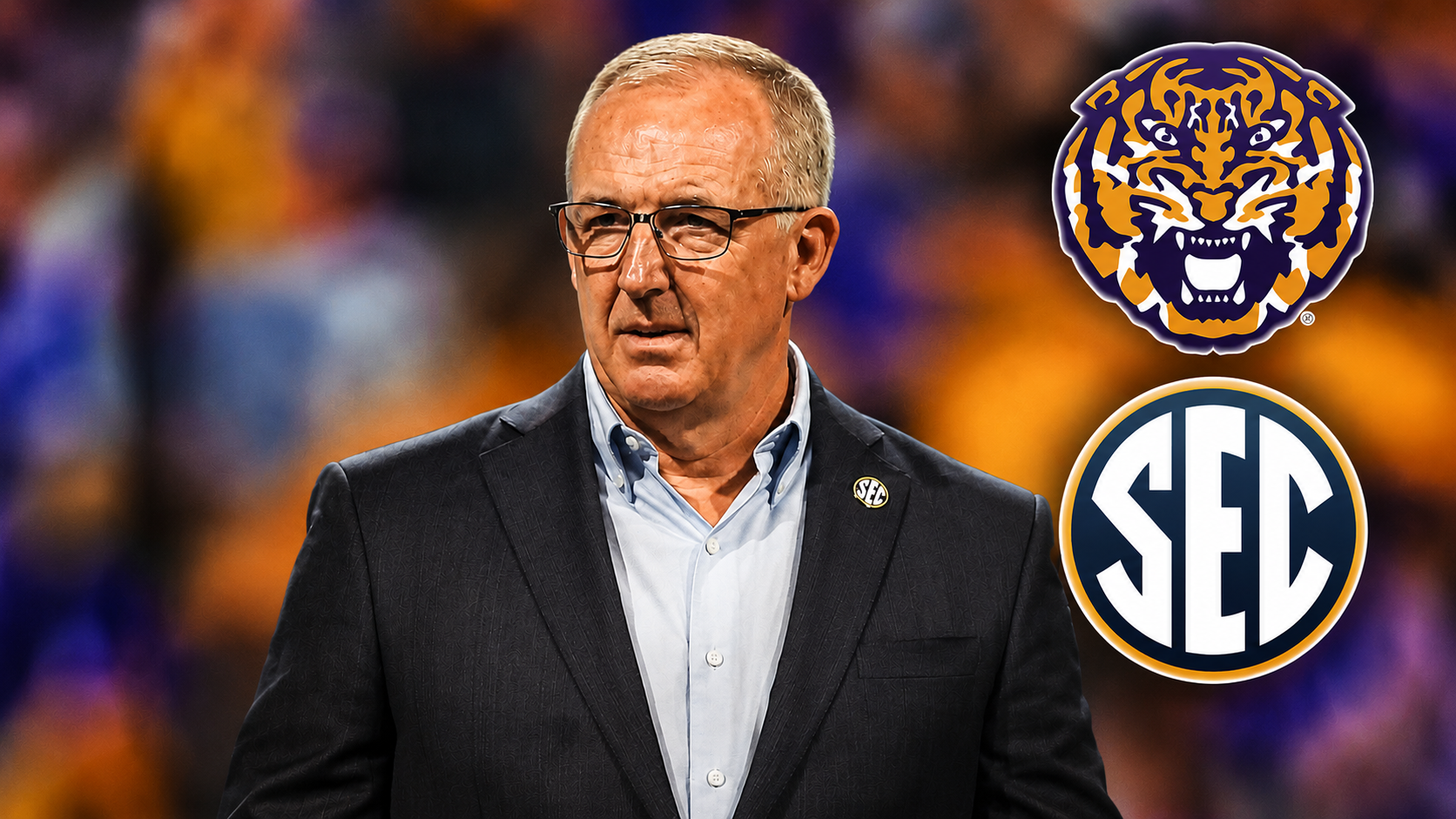
The SEC is now suing one of its own founding members.
In an extraordinary escalation Thursday, the Southeastern Conference filed a federal lawsuit against LSU, head football coach Lane Kiffin and university leadership as the two sides continued fighting over whether former professional athletes can return to college football.
The lawsuit was filed in the U.S. District Court for the Northern District of Alabama while SEC commissioner Greg Sankey was roughly 400 miles away, testifying in a Baton Rouge courtroom in a separate eligibility case involving athletes seeking additional college eligibility after signing professional contracts. (AP News)
It created one of the most unusual scenes in modern college athletics: the commissioner of the SEC defending his conference's authority in one courtroom while his conference simultaneously sued LSU in another.
And at the center of it all is a question that could reshape college football well beyond Baton Rouge:
When an athlete has already entered professional sports, should he ever be allowed to come back?
For LSU, that question isn't theoretical.
It could determine who Lane Kiffin is allowed to put on his roster.

The SEC Officially Sues LSU
The SEC's federal complaint names LSU's Board of Supervisors, university president Wade Rousse, athletic director Verge Ausberry and Kiffin as defendants.
The conference alleges LSU has engaged in a "deliberate and coordinated campaign" to recruit former professional football players for the 2026 season despite SEC rules designed to prevent athletes from returning to college competition after turning professional. (https://www.wafb.com)
The SEC argues LSU's actions threaten competitive balance within the conference and undermine the identity of college athletics.
According to the lawsuit, the conference believes forcing it to accept professional athletes into SEC competition interferes with its ability to define the values and standards of its own association.
The conference is seeking preliminary and permanent injunctions that would prevent LSU and its leadership from violating SEC rules concerning former professional athletes. (Reuters)
LSU told WBRZ on Thursday that it had not yet seen the lawsuit and could not comment because of the pending litigation. (WBRZ)
The lawsuit represents a stunning deterioration in the relationship between the conference and LSU, which has been an SEC member since the league's formation in 1933.
Why LSU Is Fighting the SEC
The dispute centers on athletes attempting to return to college competition after pursuing professional careers.
Among the most prominent are former Ole Miss players Dae'Quan Wright and Zxavian Harris.
Wright signed with the Cleveland Browns after playing for Kiffin at Ole Miss, while Harris spent time with the New Orleans Saints. Both have since sought another season of college football eligibility, with LSU emerging as their destination. Former Denver Broncos defensive back Blake Cotton has also been recruited by Kiffin. (AP News)
Their argument revolves around the NCAA's changing eligibility structure.
The NCAA adopted a model allowing athletes five seasons of competition within a five-year window. Players involved in the litigation argue they made decisions to pursue professional football before rules existed that could have given them another college season.
In other words, they argue they shouldn't lose an opportunity that wasn't available to them when they decided to turn professional.
That argument has sparked eligibility lawsuits across the country.
According to the NCAA, roughly 450 athletes are currently plaintiffs seeking additional eligibility through litigation. About 300 have received permission to compete, at least temporarily, while approximately 150 have been denied. (AP News)
But the LSU situation has pushed the issue into entirely new territory.
Greg Sankey Takes the Stand
While the SEC's lawsuit was being filed in Alabama, Sankey was inside Judge William Jorden's Baton Rouge courtroom defending the conference's authority.
Former professional players Harris and Wright were both present in the courtroom Thursday.
Sankey was called as the first witness and faced extensive questioning from attorneys representing the athletes. (AP News)
One of the central issues was whether the SEC independently created its restrictions on former professional athletes or whether the conference was effectively working with the NCAA to circumvent previous court orders.
Attorneys questioned Sankey about similarities between NCAA and SEC eligibility rules and why SEC schools recently adopted substantial penalties for schools using former professional players while the underlying eligibility dispute was already being litigated.
Sankey maintained the SEC acted independently.
His position was straightforward: There must remain a distinction between professional and college athletics.
He also argued that allowing former professionals back into college competition could take limited roster opportunities away from other athletes, including incoming high school players. (AP News)
Judge Gives the SEC an Early Victory
The SEC did score an important victory early in Thursday's hearing.
Judge Jorden agreed with the conference that most of the athletes involved in the broader lawsuit did not have sufficient connections to the SEC to pursue claims against the conference.
The case involves 44 athletes, but the SEC argued only seven had meaningful connections to SEC institutions.
Jorden agreed that combining the unrelated claims against the conference amounted to what Louisiana law calls "improper cumulation." Attorneys for the athletes subsequently agreed that plaintiffs without SEC ties would not pursue their claims against the conference. (WDAM)
That ruling narrowed the legal fight.
It did not, however, resolve the much larger question facing LSU.
Can the SEC Punish LSU Even if the Players Are Eligible?
That may ultimately become the most consequential question in the entire case.
The SEC has argued that NCAA eligibility and conference membership are separate issues.
In other words, even if a court says an athlete can legally return to college football, the SEC believes it still possesses the authority to tell its member institutions they cannot use that player.
And if LSU ignores that rule, the potential consequences are enormous.
The SEC has outlined penalties that could include a fine worth as much as 50% of a sport's annual operating budget, a suspension of up to half of the season for the head coach, loss of voting privileges within the conference and additional sanctions. (WDAM)
That potentially puts Kiffin and LSU in an unprecedented position.
A player could theoretically be eligible under an NCAA or court ruling while LSU could still face significant SEC punishment for putting him on the field.
The athletes' attorneys argue the conference should not be allowed to accomplish indirectly through punishment of schools and coaches what a court has prevented governing bodies from accomplishing directly through eligibility restrictions.
The SEC says that's not what is happening.
It argues that, as a voluntary association, it has an independent right to establish rules governing its own members.
The SEC Says Its Schools Are United Against LSU
LSU appears to be largely isolated within its own conference on the issue.
According to an affidavit from Sankey, SEC presidents and chancellors voted 15-0 in favor of the conference's new restrictions, with LSU's Wade Rousse abstaining. (AP News)
The dispute has even crossed state lines politically.
Georgia Attorney General Chris Carr has supported the SEC's position and encouraged Sankey to take measures against LSU if the Tigers use former NFL players.
Louisiana Attorney General Liz Murrill has gone in the opposite direction, supporting the athletes and describing the NCAA's changing eligibility structure as a "classic bait-and-switch." (The Washington Post)
A college football eligibility dispute has effectively become a fight involving universities, conferences, courts and state governments.
LSU's Roster Deadline Makes the Fight Immediate
LSU doesn't have months to wait for the legal system to sort everything out.
The Tigers face a Friday deadline to finalize their roster ahead of Saturday's season opener against Clemson at Tiger Stadium. (WDAM)
Wright has already begun practicing with LSU, although he started too late to satisfy the NCAA's required seven-day acclimatization period necessary to play against Clemson. Harris has committed to LSU, while Cotton has also been recruited by Kiffin. (The Washington Post)
That means Thursday's courtroom fight isn't simply about what college football might look like years from now.
It directly affects LSU's 2026 roster.
And potentially its season.
College Football Has Entered Uncharted Territory
College football has spent the past several years tearing down many of the boundaries that once defined the sport.
Players can transfer more freely.
Athletes can earn millions through NIL and revenue-sharing arrangements.
Eligibility rules continue to change.
Roster construction increasingly resembles professional free agency.
Now the sport is confronting perhaps its most uncomfortable boundary yet: the line between college athlete and professional athlete.
The SEC wants that line to remain unmistakable.
LSU is challenging how and where it should be drawn.
And the consequences could extend far beyond Wright, Harris, Cotton or even LSU.
If former professional players can successfully regain college eligibility, coaches across the country could suddenly have an entirely new pool of talent available for roster construction.
If conferences can independently prevent their members from using those players, schools could find themselves navigating conflicting NCAA rules, conference regulations and court orders.
That is why what happened Thursday matters.
This is no longer simply an eligibility dispute.
The SEC has sued LSU.
Its commissioner has taken the witness stand.
State attorneys general have entered the fight.
And one of college football's most powerful conferences is openly battling one of its most prominent members over a fundamental question about what a college athlete is allowed to be.
For decades, the road in football moved in one direction: high school to college to the pros.
LSU and the athletes at the center of this case are challenging whether that road should now run both ways.
And the courts may ultimately decide the answer. (AP News)