

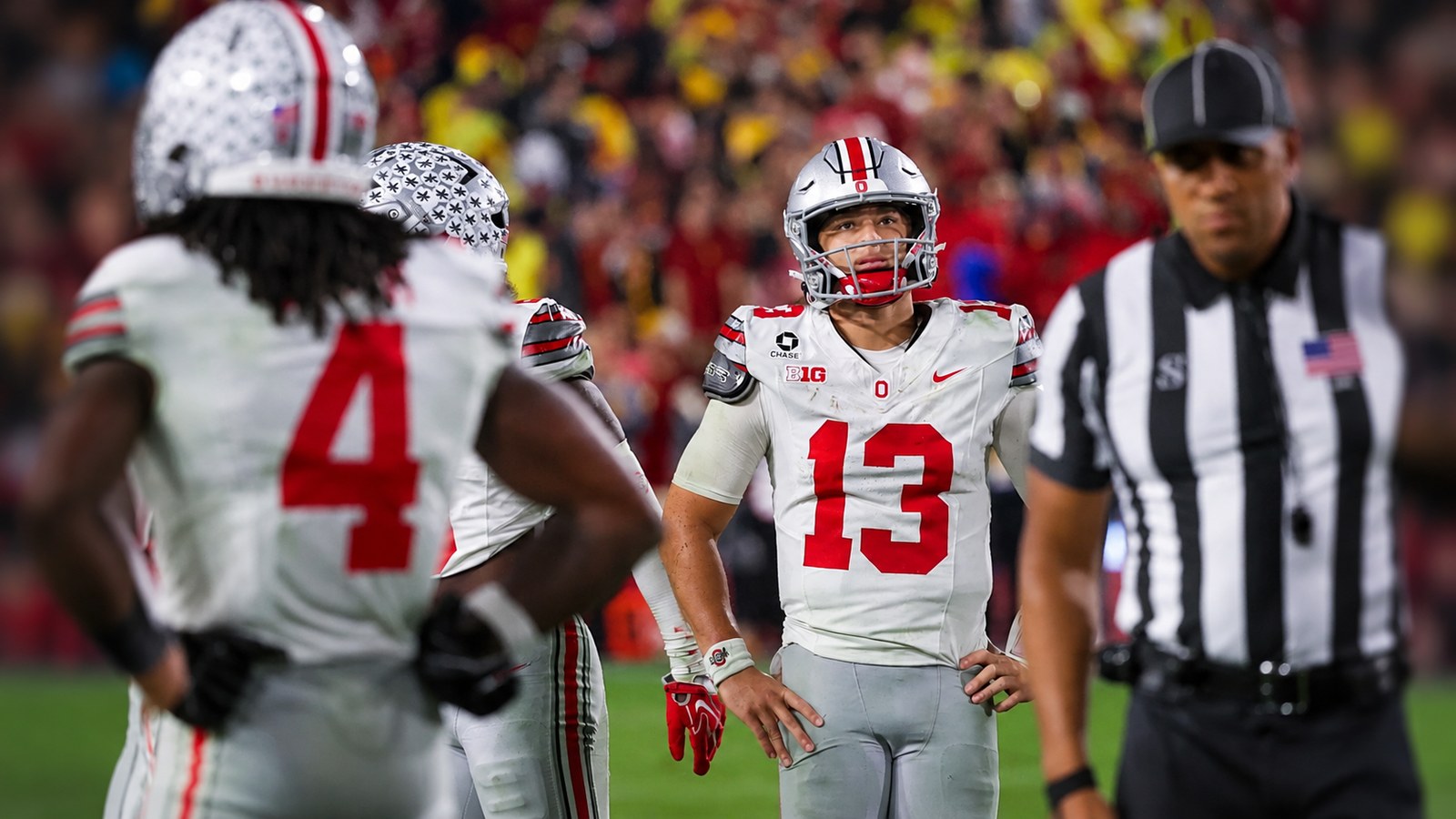
For a program measured in championships, the margin between a disappointing Saturday and a disappointing season can be remarkably thin.
Ohio State entered the weekend ranked No. 2 nationally, firmly positioned among college football's leading national championship contenders. The Buckeyes left Los Angeles with their second defeat, a nine-spot fall in the Associated Press poll and a growing collection of questions that suddenly feel far more urgent than they did a week ago.
USC's stunning 30-18 victory Saturday night did more than disrupt Ohio State's season. It exposed offensive inconsistencies, raised concerns about the Buckeyes' quarterback situation and delivered a potentially devastating blow to their College Football Playoff positioning.
Ohio State is now 6-2 overall and 4-1 in Big Ten play. The Buckeyes have fallen to No. 11 in the latest AP Top 25, their lowest ranking of the season and their first appearance outside the top 10 in five years.
For head coach Ryan Day, the circumstances are becoming increasingly uncomfortable.
And with Oregon coming to Columbus on Saturday, there is little time to find answers.
Ohio State's national championship aspirations are not dead. But the Buckeyes are dangerously close to losing control of their own postseason destiny.
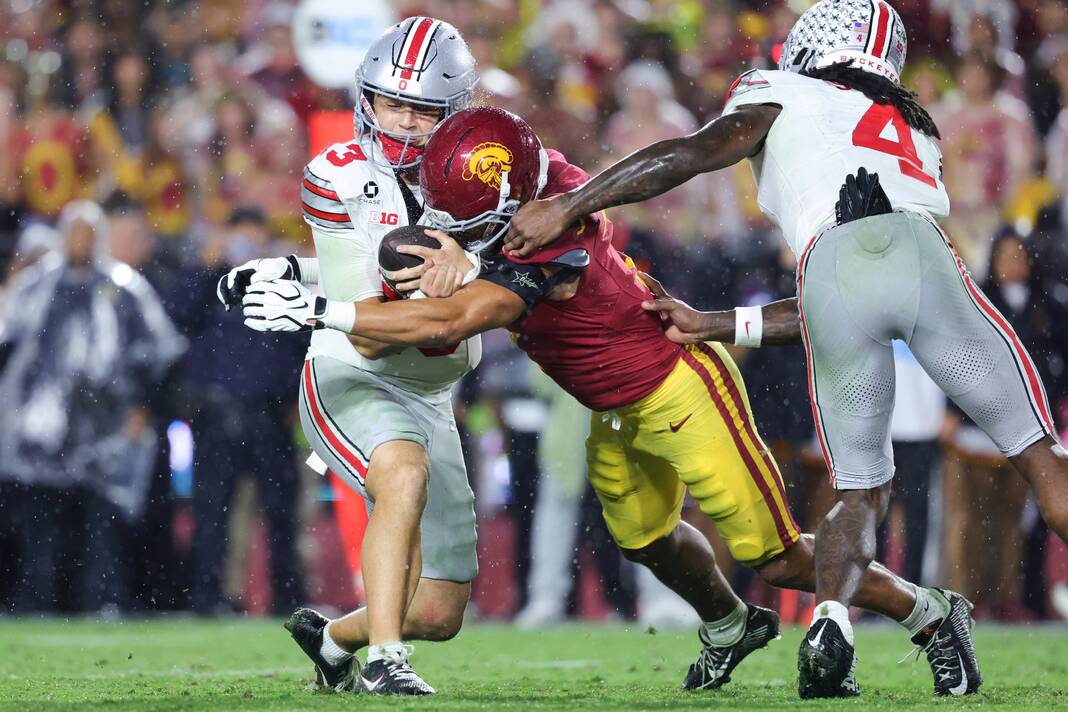
A Stunning Collapse in Los Angeles
The final score only tells part of the story.
Against a USC team that entered the weekend unranked and had scored just seven points in a loss to Wisconsin the previous week, Ohio State struggled to establish any offensive consistency when it mattered most.
The Trojans wasted little time announcing their intentions.
On USC's second offensive play, quarterback Jayden Maiava connected with freshman wide receiver Trent Mosley for a 69-yard touchdown that immediately placed the Buckeyes on their heels.
It was a startling development for an Ohio State defense that had not surrendered a play longer than 36 yards all season.
USC continued to attack.
The Trojans led 14-3 after the opening quarter and extended their advantage to 20-9 by halftime. Ohio State moved the football, but promising drives repeatedly ended without touchdowns.
Despite accumulating 192 yards on its first five possessions, the Buckeyes settled for three field goals.
That inability to finish drives became the defining offensive failure of the night.
Ohio State eventually finished with 464 total yards, 25 first downs and nearly 40 minutes of possession. USC managed just 338 yards and 15 first downs.
Yet the Trojans won by 12 points.
For a team with Ohio State's offensive talent, those numbers are difficult to reconcile.
The Buckeyes controlled large portions of the game statistically but failed to convert that control into points.
Freshman quarterback Luke Fahey completed 21 of 38 passes for 260 yards and one touchdown in his first career start. Running back Bo Jackson added 121 rushing yards, while star receiver Jeremiah Smith recorded 10 receptions for 83 yards.
Smith's one-yard touchdown reception with 2:12 remaining finally gave Ohio State its first touchdown of the evening.
By then, the outcome was effectively decided.
USC had spent nearly the entire night demonstrating that explosive plays, timely execution and red-zone efficiency matter more than impressive yardage totals.
For Ohio State, it was a painful lesson at precisely the wrong time.
The Quarterback Situation Has Become a Major Concern
Perhaps the biggest question surrounding Ohio State's postseason outlook centers on its quarterback position.
The Buckeyes were without injured starter Julian Sayin against USC, forcing freshman Luke Fahey into his first collegiate start in one of the most hostile environments on the schedule.
Fahey demonstrated flashes of potential, particularly when given opportunities to push the ball downfield.
But replacing an established starting quarterback in the middle of a national championship race is an enormous challenge, especially against quality opposition.
Ohio State's offense looked noticeably less efficient without Sayin.
The Buckeyes struggled to capitalize on scoring opportunities and failed to consistently finish drives despite moving the ball between the 20-yard lines.
Fahey should not shoulder the entire responsibility for Saturday's defeat.
The offensive line, running game, play-calling and defensive breakdowns all contributed to the loss.
Nevertheless, quarterback uncertainty creates a significant obstacle for a team hoping to compete against the country's best programs.
If Ohio State must continue relying on Fahey, Day and his offensive staff will need to construct an attack that maximizes the freshman's strengths while limiting situations that expose his inexperience.
That could mean a heavier emphasis on Jackson and the running game, quicker passing concepts and more deliberate efforts to involve Smith in high-percentage opportunities.
The Buckeyes have enough talent to remain dangerous.
The question is whether they can develop the offensive consistency necessary to win against elite opponents before November slips away.
Ohio State's Defense Is No Longer Untouchable
For much of the season, Ohio State's defense appeared capable of compensating for almost any offensive shortcomings.
The Buckeyes entered Saturday having established themselves as one of the nation's most imposing defensive units.
USC changed that perception.
Maiava threw for 222 yards and a touchdown, but it was the Trojans' ability to generate explosive plays that proved especially damaging.
Mosley's 69-yard touchdown reception provided the first warning.
Later, freshman tight end Mark Bowman turned a reception into a spectacular 70-yard gain, helping set up another USC touchdown that extended the lead to 27-9.
Those plays were particularly concerning because they exposed vulnerabilities that had rarely appeared earlier in the season.
Championship defenses are not necessarily expected to prevent every big play. They are, however, expected to limit explosive opportunities and prevent isolated mistakes from becoming game-changing moments.
Against USC, Ohio State failed on both fronts.
The Trojans scored 30 points despite possessing the football for just over 20 minutes.
That level of offensive efficiency against a defense of Ohio State's caliber should concern Day and his coaching staff.
With several important conference games remaining, the Buckeyes must quickly determine whether Saturday's performance was an isolated breakdown or evidence of a larger problem.
Two Losses, Four Games Remaining and Almost No Margin for Error
Ohio State's playoff situation is complicated, but hardly hopeless.
The expanded 12-team College Football Playoff provides opportunities for highly regarded programs to recover from multiple regular-season defeats.
A two-loss record does not automatically eliminate a team from national championship contention.
What matters is the quality of those losses, the strength of a team's victories and how its overall résumé compares with other contenders.
Ohio State has arguments in its favor.
Its 31-14 road victory against Iowa and 19-15 win at Indiana provide valuable résumé-building results. The Buckeyes' first loss also came by a single point, 24-23, on the road against Texas.
Those performances demonstrate that Ohio State remains capable of competing against talented opponents.
But the loss to USC is different.
The Buckeyes were favored to win against an unranked opponent and instead suffered a double-digit defeat in a game that exposed significant weaknesses.
Their fall from No. 2 to No. 11 in Sunday's AP poll reflects the damage.
The initial College Football Playoff rankings, scheduled for Tuesday, will provide a more meaningful indication of where Ohio State stands in the committee's evaluation.
And the remaining schedule offers little room for mistakes.
Ohio State's Remaining Regular-Season Schedule
| Date | Opponent | Location |
|---|---|---|
| Nov. 7 | Oregon | Home |
| Nov. 14 | Northwestern | Home |
| Nov. 21 | Nebraska | Away |
| Nov. 28 | Michigan | Home |
Ohio State can still finish the regular season 10-2.
Doing so would give the Buckeyes a compelling case for playoff consideration, particularly if they defeat Oregon and finish November with four consecutive victories.
But another defeat would leave Ohio State at 9-3, a position that would make an at-large playoff invitation considerably more uncertain.
The Buckeyes can no longer afford to assume their national reputation will compensate for additional mistakes.
From this point forward, the results must speak for themselves.
Oregon Could Determine the Direction of Ohio State's Season
Saturday's matchup against Oregon has suddenly become one of the most important games of Ryan Day's tenure.
The Ducks arrive in Columbus with their own postseason ambitions, creating a matchup between two programs that entered the season expecting to compete for national championships.
For Ohio State, the opportunity is enormous.
A victory would restore momentum, strengthen its playoff résumé and demonstrate that the USC defeat did not permanently damage the team's confidence.
It would also provide evidence that the Buckeyes can respond to adversity rather than allow one disappointing performance to define their season.
A loss would be far more consequential.
Ohio State would fall to 6-3 with three regular-season games remaining, creating a steep uphill battle for playoff consideration.
The pressure would then shift almost entirely toward salvaging the season and defeating Michigan in the regular-season finale.
For a program with Ohio State's expectations, that would represent a dramatic change from its preseason aspirations.
The Buckeyes do not need perfection against Oregon.
They need offensive efficiency, defensive discipline and the ability to capitalize on scoring opportunities.
Most importantly, they need to prove that Saturday's collapse in Los Angeles was an exception rather than a warning of what lies ahead.
Ryan Day Faces Another Defining November
Few college football coaches operate under the level of scrutiny that follows Ryan Day.
At Ohio State, winning 10 games is often treated as an expectation rather than a significant accomplishment.
Conference championships, victories over Michigan and national titles are the measurements that ultimately define success.
That reality makes the closing month of the regular season particularly important.
Day has assembled a roster featuring some of the country's most talented players. Ohio State possesses the recruiting strength, athleticism and resources associated with a national championship program.
But talent alone does not guarantee success in college football.
The Buckeyes must demonstrate an ability to execute in critical situations, overcome injuries and respond when opponents challenge them physically.
Against USC, they failed to do those things consistently.
The responsibility now falls on Day to ensure those failures do not become recurring problems.
A strong November could transform the USC loss into a temporary setback on the road to another playoff appearance.
A disappointing finish would invite difficult questions about why a team with Ohio State's talent failed to meet expectations.
The difference between those outcomes could be determined over the next several Saturdays.
The Verdict: Ohio State Is in Trouble, but Its Season Is Far From Over
There is a difference between a team being eliminated from national championship contention and a team showing signs that it might not be capable of winning a championship.
Ohio State has not reached the first point.
But the Buckeyes are beginning to approach the second.
Their loss to USC revealed weaknesses that cannot be dismissed simply because the team was playing without its starting quarterback.
The defense surrendered explosive plays. The offense failed to convert opportunities into touchdowns. And a team ranked No. 2 in the country was thoroughly outplayed in the moments that mattered most.
Those are legitimate concerns for a program hoping to compete against the nation's best in December and January.
Still, the season is not lost.
Ohio State has four games remaining, including significant opportunities to strengthen its postseason résumé.
Win those games, and the conversation surrounding the Buckeyes could look dramatically different by the end of November.
Lose again, and the road to the College Football Playoff becomes increasingly difficult.
For now, the Buckeyes remain talented, dangerous and capable of competing with almost anyone.
But they are no longer operating from a position of strength.
Ohio State entered October dreaming of another national championship. It enters November fighting to ensure that dream survives.
And with Oregon coming to Columbus, the Buckeyes are about to find out just how much fight they have left.