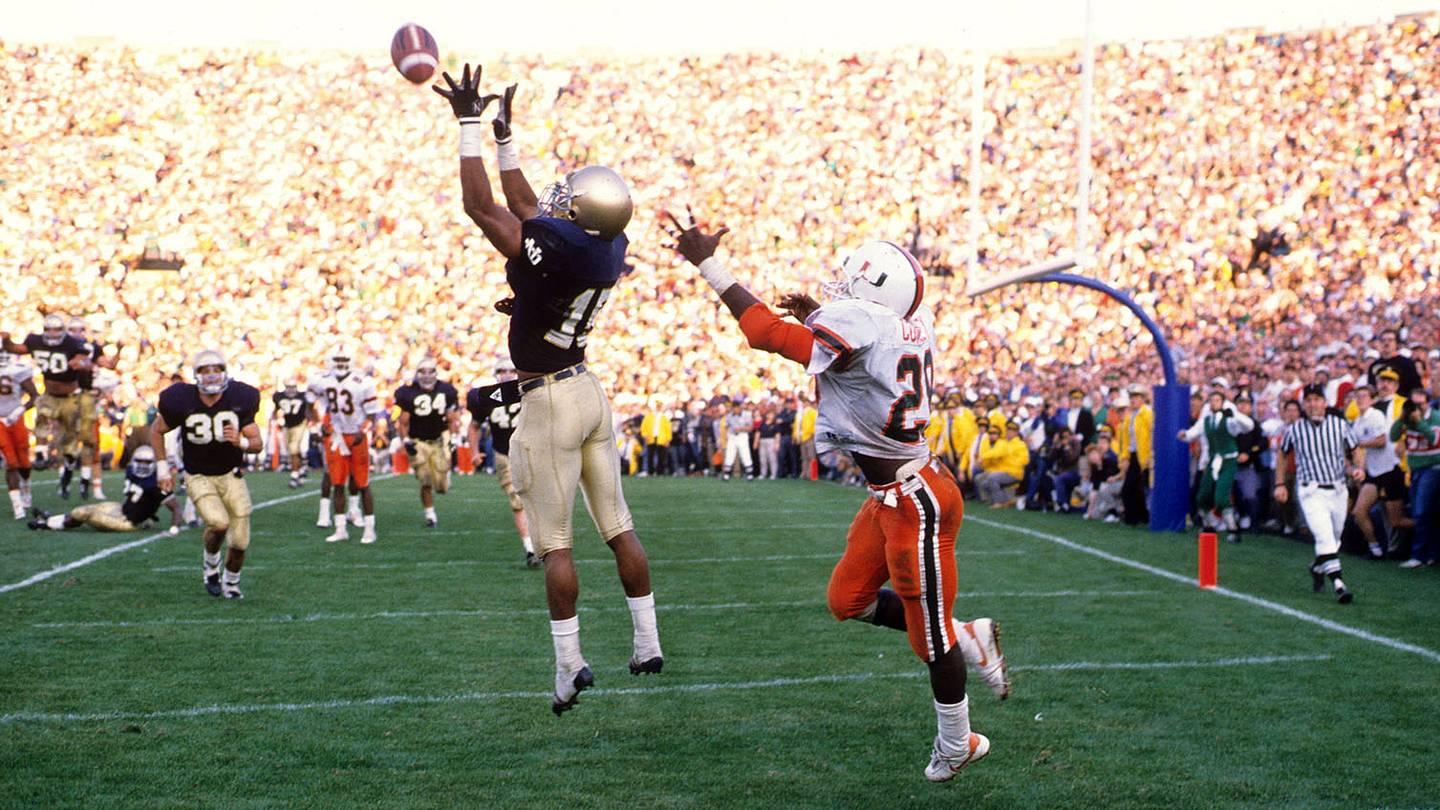

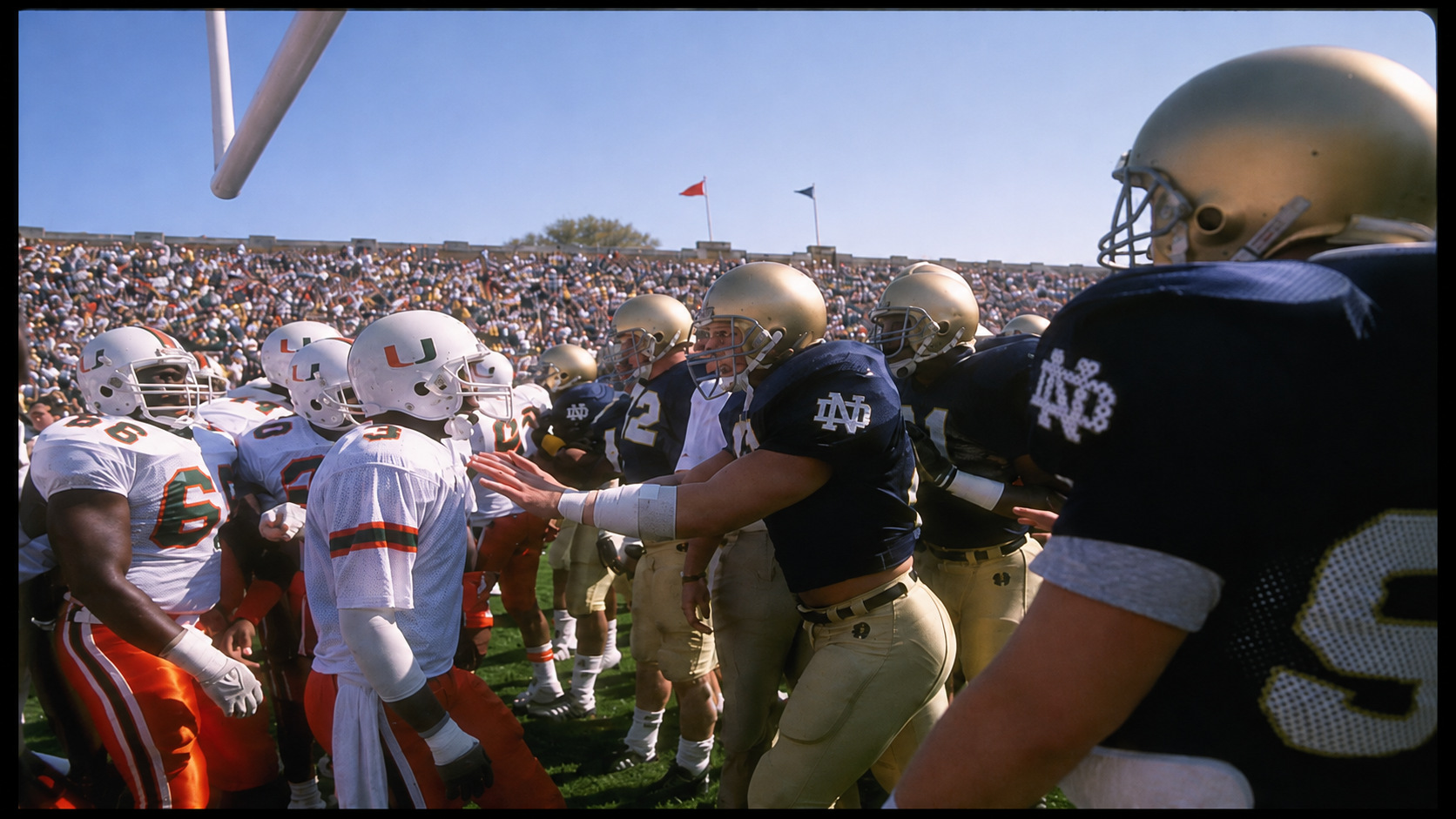
Thirty-eight years ago, Miami arrived at Notre Dame Stadium ranked No. 1 in the country, carrying an undefeated record and the expectation that another national championship was within reach.
Waiting for the Hurricanes was fourth-ranked Notre Dame.
The game that followed became one of the most celebrated, controversial and consequential Saturdays in college football history.
Now, nearly four decades later, the circumstances are almost impossible to ignore.
No. 1 Miami. No. 4 Notre Dame. South Bend. National championship implications.
Some rivalries are built on geography. Others are fueled by annual meetings and conference championships. Miami and Notre Dame share something different: a history of colliding when the stakes are at their highest.
On Saturday night, November 7, that history will have another chapter.
And with the College Football Playoff picture beginning to take shape, the question is no longer whether this is one of the biggest games of the season.
It's whether any regular-season game in 2026 will carry more significance.
A rivalry built for the national stage
College football has changed dramatically since Miami and Notre Dame dominated the national conversation in the late 1980s. Conference realignment, the transfer portal, name, image and likeness opportunities, and an expanded playoff have transformed nearly every aspect of the sport.
But the history separating these two programs has lost none of its significance.
In 1988, the Hurricanes traveled to South Bend ranked No. 1, riding a 36-game regular-season winning streak. Notre Dame, ranked fourth under legendary head coach Lou Holtz, was determined to establish itself as a national championship contender.
The matchup became known as the "Catholics vs. Convicts" game, a controversial nickname that captured the hostility surrounding the rivalry.
Notre Dame won 31-30 after Miami's late two-point conversion attempt failed, handing the Hurricanes a devastating defeat.
The Fighting Irish went on to win the national championship.
A year later, Miami returned the favor, defeating Notre Dame 27-10 on its way to another national title.
Those games helped establish the rivalry as something bigger than football. They represented competing identities, contrasting cultures and two programs unwilling to surrender their place atop the sport.
The rivalry resurfaced in the 2025 season opener, when Miami edged Notre Dame 27-24. The Hurricanes subsequently reached the national championship game, ultimately finishing as runners-up.
Saturday's meeting presents another opportunity to create a defining moment.
And once again, the rankings have aligned almost perfectly with history.
Miami has the nation's most explosive offense. Now comes its toughest test.
For much of the 2026 season, Miami has looked like the most dangerous offensive team in college football.
Under head coach Mario Cristobal, the Hurricanes have assembled an attack capable of overwhelming opponents through the air while maintaining the physicality necessary to control games on the ground.
Miami enters Saturday undefeated at 8-0, averaging an FBS-leading 47.6 points per game and 534.9 total yards per contest.
At the center of that production is quarterback Darian Mensah.
Mensah has provided the Hurricanes with the consistency and explosive passing ability required to compete for a national championship. His connection with standout receiver Malachi Toney has developed into one of the most dangerous combinations in the country.
Toney has emerged as a matchup nightmare, capable of creating separation, extending plays after the catch and delivering in critical moments.
Those qualities were on display Saturday against North Carolina.
Miami escaped Chapel Hill with a 38-35 victory, rallying from a fourth-quarter deficit to remain undefeated. Mensah completed 22 of 29 passes for 274 yards and three touchdowns, while Toney caught seven passes for 75 yards and two scores.
The game-winning touchdown came on a nine-yard connection between Mensah and Toney after a crucial fourth-quarter takeaway by Miami's defense.
It was the kind of victory championship contenders often need: imperfect, uncomfortable and ultimately successful.
But it also exposed questions Notre Dame will be eager to exploit.
North Carolina moved the football effectively through the air, finishing with 341 passing yards. Miami's defense has been dominant against the run, surrendering just 60.8 rushing yards per game, but has allowed 251.9 passing yards per contest.
That disparity could become one of the defining factors Saturday.
Notre Dame possesses both the quarterback talent and offensive balance to challenge Miami's secondary.
For Cristobal and the Hurricanes, this is an opportunity to prove they can win against an elite opponent even when their offense cannot dictate every possession.
Notre Dame's defense could be the difference
If Miami enters the matchup with college football's most explosive offense, Notre Dame counters with arguably its most complete defense.
The Fighting Irish have established themselves as one of the nation's most disciplined and physically imposing teams under head coach Marcus Freeman.
Notre Dame enters Saturday at 7-1, allowing just 236.1 total yards and 13.4 points per game.
Those numbers place the Irish first nationally in total defense and fifth in scoring defense.
Opponents have struggled to establish offensive rhythm against Notre Dame's combination of front-seven strength, coverage discipline and defensive speed.
Miami, however, presents a challenge unlike anything the Irish have faced this season.
The Hurricanes' ability to stretch defenses horizontally and vertically means Notre Dame cannot afford repeated coverage breakdowns or missed tackles in space.
Containing Mensah without sacrificing protection against Miami's running game will require a nearly flawless defensive performance.
Notre Dame's offense, meanwhile, has more than enough firepower to create problems of its own.
Quarterback CJ Carr leads an Irish attack averaging 40.4 points per game, fifth nationally.
Running back Nolan James Jr. has emerged as a dynamic weapon, giving Notre Dame a versatile offensive option capable of producing explosive plays.
In Saturday's 35-13 victory over Navy, Carr passed for 210 yards and two touchdowns, while James rushed for 107 yards and two scores on just nine carries.
The Irish trailed briefly in the second quarter before scoring 28 unanswered points, showcasing their ability to adjust and take control of a game.
But Miami's defensive front will provide a dramatically different challenge.
The Hurricanes enter with the nation's top-ranked rushing defense. If Notre Dame cannot establish balance offensively, the responsibility could fall squarely on Carr to challenge Miami through the air.
For a quarterback leading a national championship contender, few opportunities offer a bigger stage.
The expanded College Football Playoff has changed the consequences of losing a major regular-season game.
A defeat no longer automatically eliminates a national championship contender.
But that does not diminish what is at stake Saturday.
For Miami, a victory in South Bend would strengthen its position among the nation's elite while providing one of the most impressive résumé-building wins of the season.
An undefeated Hurricanes team with a road victory over a top-five opponent would have a compelling argument for the No. 1 seed entering the final stretch of the regular season.
A loss, however, would complicate Miami's pursuit of an unbeaten season and introduce additional pressure into the ACC championship race.
Notre Dame faces a different situation.
The Fighting Irish already suffered a loss at BYU earlier this season. As an independent program without a conference championship game to strengthen its postseason résumé, Notre Dame has fewer opportunities to overcome another defeat.
A victory over the nation's top-ranked team would dramatically improve the Irish's playoff positioning and could establish them as legitimate national championship contenders.
A second loss would not necessarily end Notre Dame's postseason hopes, but it would significantly reduce its margin for error.
That is what makes Saturday's matchup particularly compelling.
One team is attempting to protect perfection.
The other is trying to secure the signature victory that could define its season.
And both understand that playoff positioning in November can determine the road to a national championship in January.
Three matchups that could decide the game
1. Darian Mensah vs. Notre Dame's secondary
Miami's passing attack has been among the nation's most productive, averaging more than 330 yards per game.
Notre Dame, meanwhile, allows just 150.8 passing yards per contest.
Something will have to give.
If Mensah consistently finds Toney and Miami's other offensive weapons, the Hurricanes could force Notre Dame into an uncomfortable high-scoring contest.
If the Irish disrupt his timing and create negative plays, Miami could find itself playing from behind for extended stretches.
2. CJ Carr vs. Miami's pass defense
Miami's defensive front has been exceptional against opposing rushing attacks, but its secondary has been considerably more vulnerable.
Carr's ability to exploit that weakness could determine whether Notre Dame can match Miami offensively.
The Irish will need more than occasional explosive plays. Sustained drives, third-down conversions and efficient red-zone execution could prove essential.
3. Turnovers and field position
In a matchup between two highly ranked teams with explosive offenses, one mistake can change everything.
Notre Dame enters the game with a plus-14 turnover margin, one of the best figures nationally. Miami is also on the positive side at plus-six.
Neither team can afford to give its opponent additional possessions.
For Notre Dame, forcing turnovers could be the most effective way to neutralize Miami's offensive production.
For Miami, protecting the football and avoiding unnecessary penalties will be particularly important in a hostile road environment.
Why this game feels different
There is something uniquely compelling about a rivalry that does not need an annual meeting to maintain its relevance.
Miami and Notre Dame do not share a conference. They do not compete for a traditional rivalry trophy. Their schedules rarely guarantee another opportunity for revenge the following season.
Yet whenever these programs meet with national championship implications, college football pays attention.
Saturday's game will also mark Miami's first AP top-five matchup since November 2005, when the fifth-ranked Hurricanes defeated No. 3 Virginia Tech.
For Notre Dame, it will be the program's first top-five matchup at home since November 7, 2020, when the fourth-ranked Irish defeated No. 1 Clemson in double overtime.
The symmetry is remarkable.
November 7. A top-five opponent. A nationally televised showdown in South Bend.
The ingredients are there for another unforgettable night.
College football's biggest games are not always determined by rankings alone. History, atmosphere, postseason consequences and the quality of the teams involved all contribute to the significance of a matchup.
Miami and Notre Dame check every box.
There are other enormous games on Saturday's schedule, including No. 2 Georgia against No. 12 Ole Miss and No. 3 Utah against No. 7 BYU.
But none carries quite the same combination of historic significance, national championship implications and star power.
And with ESPN's College GameDay scheduled to visit South Bend before the primetime kickoff, the attention surrounding this game will only intensify.
The verdict: College football's biggest stage belongs to Miami and Notre Dame
In a sport increasingly defined by constant change, Saturday offers something familiar.
Two historic programs. Two legitimate national championship contenders. An undefeated No. 1 team entering one of the country's most iconic stadiums.
For Miami, the opportunity is about validation.
Cristobal has rebuilt the Hurricanes into a national contender, but winning a game of this magnitude on the road would provide another compelling measure of just how far the program has come.
For Notre Dame, the opportunity is about reaffirmation.
Freeman has established a program capable of competing with the nation's best. Defeating the country's top-ranked team would reinforce the belief that the Irish belong among college football's national championship favorites.
Of course, the winner will not be guaranteed a championship, and the loser will not necessarily be eliminated from contention.
There is still too much football remaining.
But years from now, when the story of the 2026 college football season is told, Saturday night in South Bend could occupy a central chapter.
In 1988, Notre Dame's victory over Miami helped propel the Fighting Irish toward a national championship.
Thirty-eight years later, the Hurricanes return to the same stadium with the same No. 1 ranking, facing the same fourth-ranked opponent.
Different players. Different coaches. Different era.
The stakes are familiar.
And when the lights come on in South Bend, college football may once again find itself watching a game that helps define an entire season.