

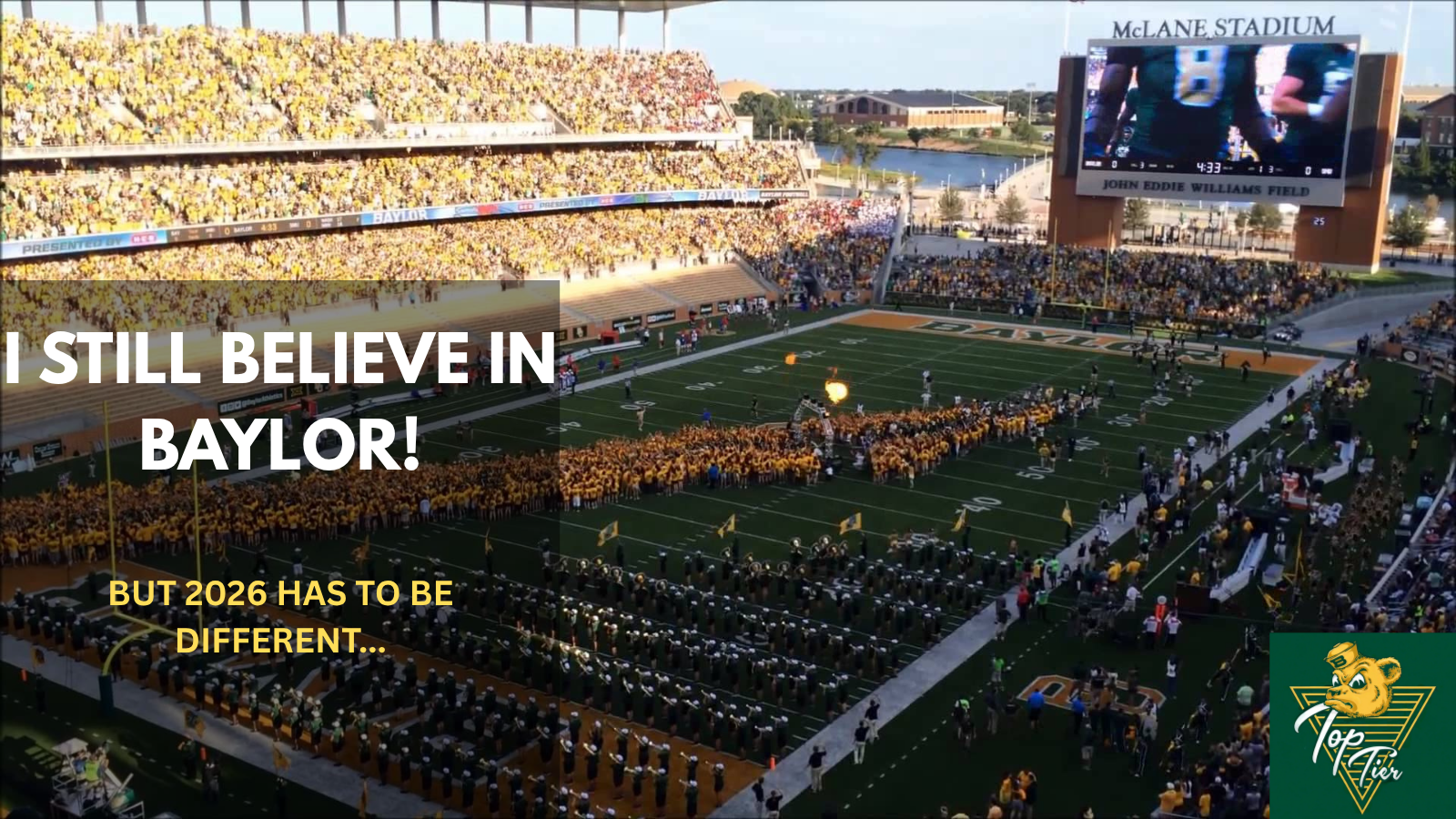
Baylor football is finally here.
And judging by the questions that came in from Baylor fans, optimism isn't the only thing surrounding this team.
There is excitement.
There is frustration.
There is skepticism.
And, perhaps more than anything, there is a lot of “prove it.”
I understand it.
I'm a Baylor fan too. I want to believe this team is different. I want to believe DJ Lagway can become the quarterback Baylor has been waiting for. I want to believe Jake Spavital can build one of the best offenses in the Big 12.
But I also watched what happened last year.
Baylor finished 5-7 after entering the season with legitimate expectations of taking another step forward. The Bears went 3-6 in Big 12 play and ended the season with losses to Utah and Arizona. Dave Aranda's post-2021 record now includes seasons of 6-7, 3-9, 8-5 and 5-7. Overall, his Baylor record entering 2026 is 36-37.
That's why the phrase I kept seeing in the questions was so perfect:
Nobody wants to get Dallas Cowboy-ed again.
So let's talk about it.
What makes this year different from last year?
This is the question I think every Baylor fan should be asking.
Because there is a difference between having reasons to be optimistic and actually having reasons to believe.
I think Baylor has more legitimate reasons to be optimistic this year than it did heading into last season.
The first is obvious: DJ Lagway.
The former five-star Florida quarterback brings a level of physical talent that Baylor hasn't had at the position in quite some time. He has the arm strength to attack every level of the field and the athleticism to create outside the structure of a play.
That does not mean he's a finished product.
He isn't.
Lagway threw 16 touchdowns against 14 interceptions for Florida in 2025, and national coverage has pointed directly at his turnover history as one of the biggest questions surrounding his move to Waco.
But there's a reason I'm still excited.
Jake Spavital.
Spavital isn't just another offensive coordinator to me. I honestly believe he may be the most important piece of Baylor's coaching staff.
In two seasons running Baylor's offense, Spavital helped turn the Bears into one of the country's most productive offenses. Baylor ranked fourth nationally in passing offense and 18th in total offense in 2025.
Now give that system a quarterback with Lagway's physical tools.
That's what gets me excited.
Spavital has already shown that he can build an offense around the players he has. The next step is seeing what he can do with a quarterback who has the ability to threaten defenses vertically and with his legs.
The other major difference is the trenches.
Baylor badly needed to improve there, particularly on defense, and national coverage has identified the defensive line and overall physicality as major swing points for this team.
Joe Klanderman is also taking over the defense.
Klanderman spent six seasons coordinating Kansas State's defense, and his units consistently played at a high level. The change is particularly interesting because Dave Aranda is no longer personally carrying the defensive play-calling responsibility he had taken on in recent seasons.
Then there is the portal.
Baylor attacked the roster aggressively, and not just by collecting names. The Bears targeted experienced players at positions where they needed immediate improvement.
That's important because last year's problem wasn't that Baylor couldn't move the football.
The problem was that Baylor couldn't consistently stop people.
The Bears scored 31.1 points per game and averaged 451.1 yards last season, but they allowed 32.6 points per game.
So, yes, I believe this year's team is different.
But I don't believe it just because it's September.
That's where the optimism ends and the proof begins.
Why should we trust Dave Aranda?
Here's where I'm probably going to agree with most Baylor fans.
I don't think Dave Aranda is a bad person.
However I don't think he's a great football coach.
And I don't think Baylor would be unreasonable for appreciating everything he accomplished here.
He won the Big 12.
He took Baylor to 12 wins.
He won the Sugar Bowl.
None of that gets erased.
But I don't want him leading Baylor anymore.
And I think it's important to explain why.
Aranda's Baylor tenure after the 2021 championship has simply not been good enough.
Baylor went 6-7 in 2022.
Then 3-9 in 2023.
Then 8-5 in 2024.
Then 5-7 in 2025.
That's 22 wins and 28 losses over those four seasons.
At some point, you have to stop talking about rebuilding and start talking about results.
National media agrees that Aranda enters this season under enormous pressure. Sports Illustrated labeled 2026 a make-or-break season for him, and Reuters included him among the coaches entering 2026 on the hot seat.
And that's why I don't think Baylor fans should be arguing about whether Aranda is a good guy.
He is.
The question is whether he's the right head coach for Baylor now.
I don't believe he is.
So what would it take for you to keep Aranda?
For me?
Almost a miracle.
I'm talking 10-2 or 11-1 with a Big 12 Championship appearance.
And even then, I'd have to be convinced the program had genuinely changed.
That's not me trying to move the goalposts.
It's because Aranda has already had time.
He's had the 12-win season.
He's had the huge expectations.
He's had the benefit of patience.
He's had multiple opportunities to establish a culture.
And Baylor is still trying to figure out what it wants to be.
If the Bears go 7-5 this year, I personally don't think that changes the conversation.
If they go 8-4, I'm still probably looking for a new coach.
Even 9-3 would leave me asking whether this is a true turnaround or simply another good season followed by a reset.
That's how far the bar has fallen for me.
If Aranda is fired, could Baylor actually land a big-name coach?
I think Baylor fans may be underrating this job.
A lot.
I don't look at Baylor and see a program that should be begging somebody to take the job.
I see Waco.
I see Texas recruiting.
I see a Power Four program.
I see McLane Stadium.
I see a university with a strong academic reputation.
I see an administration that has the ability to invest in athletics.
And, perhaps most importantly, I see an offensive coordinator who I believe is extremely valuable.
Could Baylor attract a coach who has struggled at another major program?
Absolutely.
Look at Lincoln Riley as an example of the type of candidate I mean—not because I'm predicting Baylor would hire him, but because his career illustrates the concept. A coach can struggle or lose momentum at one major school and still possess the recruiting ability, offensive pedigree and organizational experience that make him attractive somewhere else.
Would Riley actually be the right fit for Baylor?
That's an entirely different debate.
But I think the larger point stands:
Baylor should think bigger than it has been thinking.
There is also another path I really like.
Find a proven Group of Five head coach who has demonstrated that he can build something.
Then keep Jake Spavital.
That would probably be my preferred outcome.
Because I don't want to lose Spavital simply because Baylor changes head coaches.
I think what he is doing offensively is too valuable.
And if Baylor can find a head coach who understands that and is willing to build the right staff around him, I think that could be a home run.
Could Spavital himself become the head coach?
I'm not ready to say that's the best option.
But I absolutely think he deserves to be part of the conversation.
What is Baylor's biggest problem?
The trenches.
It's not complicated.
If the offensive line can keep Lagway upright and the defensive line can keep opposing offenses from running through Baylor's front seven, this team could be dangerous.
That's where my optimism comes from.
I trust Spavital's offense.
I trust what he has shown he can do with quarterbacks.
I trust his understanding of offensive personnel.
And I believe the offensive skill talent is good enough to cause problems.
But none of that matters if Lagway is constantly under pressure.
And on the other side, it doesn't matter how explosive Baylor's offense is if the defense allows opponents to dictate the game on the ground.
Baylor doesn't need to have the best offensive and defensive lines in the country.
It needs them to become good enough that the rest of the roster can matter.
If that happens and Lagway stays healthy?
I think this team can be lethal.
The offensive line question: should we be nervous?
I understand why Baylor fans are nervous.
We've seen enough bad offensive-line play to know how quickly it can derail a season.
But I am more optimistic about this group than I was a year ago.
National coverage heading into the opener has focused heavily on the new faces along the offensive line. Sports Illustrated's projected two-deep has Nate Kibble and Asher Hale at guard, Koltin Sieracki at center and Kaden Sieracki at tackle, with competition still open behind them.
That isn't a guarantee that the line will be good.
It does tell me that Baylor understood the problem and attacked it.
And here's the thing:
I don't need this line to be elite.
I need it to be functional.
Give Lagway time.
Give Spavital a chance to run the offense he wants.
Create enough movement that defenses can't sell out against the passing game.
Do those three things, and I think the offense becomes extremely difficult to deal with.
Who is the transfer nobody is talking enough about?
There are obvious names.
But the players I want to watch are the guys who determine whether Baylor's foundation actually improves.
Nate Kibble and Asher Hale jump out to me for that reason.
They aren't going to get the headlines DJ Lagway gets.
They aren't going to create social-media clips every Saturday.
But if those guys stabilize the interior of the offensive line, their impact could be enormous.
That's the thing about this roster.
The transfer portal doesn't have to produce 10 stars.
It has to produce enough answers.
And Baylor has more unanswered questions on the lines than anywhere else.
Why does Baylor go for it on fourth down so much?
This is one where I think Baylor fans have a legitimate gripe—but perhaps not for the reason they think.
I'm not against going for it.
Analytics have changed football. There are situations where going for it on fourth down is absolutely the correct decision.
But I don't believe aggression should become an identity for its own sake.
Baylor attempted 49 fourth downs in 2025 and converted 26, a 53.1% success rate.
The question I'd ask isn't simply:
“Why didn't we punt?”
I'd ask:
“Why did we go for it in that specific situation?”
What's the field position?
What's the distance?
What's the score?
How much time is left?
What's the matchup?
And perhaps most importantly:
How confident are you that your offense can actually get the yard?
Because Baylor has a weapon sitting on the sideline in Palmer Williams.
And that brings me to the next question.
Why doesn't Baylor ever pin anybody deep?
I completely understand why fans feel this way.
But here's the funny part:
Baylor actually had a really good punter last year.
Williams averaged 46.92 yards per punt, and his 45.0-yard net average was exceptional.
So I'm not sure the issue is that Baylor can't pin teams deep.
The bigger issue is that Baylor sometimes doesn't give itself the opportunity to try.
That's where my frustration would be directed.
There are absolutely situations where Baylor should be aggressive.
But there are also situations where flipping the field and letting your defense make somebody drive 80 or 90 yards is the smarter football decision.
Especially if the defensive line we've been promised actually turns out to be good.
What is the most important Big 12 game?
TCU.
No question.
And there's a reason I feel strongly about it.
The Revivalry lands almost exactly in the middle of the season, on October 17, and both teams have a bye leading into the game.
That means neither team has an excuse for being unprepared.
It also gives Baylor a perfect measuring stick.
It's one of the games your players grow up knowing about.
It's one of the games fans care about most.
And it's exactly the type of game where you can learn whether a team is emotionally invested in the program.
If Baylor enters that game with two losses, I think the stakes become enormous.
If Baylor enters it with three losses?
To me, that game becomes something bigger than a rivalry game.
It becomes a referendum.
Because if Baylor loses that game and drops to 3-3, I would hope the athletic department is having some extremely serious conversations about Aranda.
And if Aranda ultimately gets fired at the end of the season, I wouldn't be surprised if people look back at that game as one of the moments where the decision became inevitable.
That's how important the Revivalry is to me.
Can Baylor have a top-30 recruiting class?
Absolutely.
And Baylor has already shown that it can recruit at that level.
The bigger issue is consistency.
The modern recruiting battle is not just about finding talented players.
It's about convincing them that Baylor is where they can win.
A player isn't going to choose Baylor because we had a great recruiting pitch in June and then go 5-7 again in November.
Winning sells recruiting.
Development sells recruiting.
NFL development sells recruiting.
And culture sells recruiting.
If Baylor can put together a strong 2026 season and prove that the roster overhaul is actually working, I think a top-30 class becomes much more realistic.
But here's where I think Baylor fans sometimes get it backward:
Recruiting isn't the cure. Winning is.
Winning makes recruiting easier.
Can smaller schools survive the NIL era?
Yes.
But it is becoming harder.
The House settlement fundamentally changed the financial structure of college athletics, including a revenue-sharing model that gives schools the ability to provide direct benefits to athletes. National reporting has also made it clear that schools with massive athletic revenues will have advantages under the new system.
But I don't think this means Baylor—or other schools outside the sport's traditional mega-brands—is doomed.
The mistake would be trying to beat the biggest programs at their own game.
Baylor needs to be smarter.
Identify players who fit.
Develop them.
Use the portal strategically.
Build donor engagement.
Create a compelling NIL story.
And most importantly:
Win football games.
I don't think smaller programs need the same amount of money to compete.
They need to spend their money better.
What needs to change with NIL?
Transparency.
Enforcement.
And some form of competitive balance.
The current system is still developing, and there are enormous questions about how revenue sharing, NIL collectives, third-party deals and roster movement will ultimately coexist.
But I don't think going backward is realistic.
College athletics has changed.
The schools that adapt fastest are going to benefit most.
Baylor can't sit around waiting for the rules to save it.
The Bears need to become one of the schools that figures out the rules faster than everyone else.
What about Linda Livingstone?
This might be the most uncomfortable question in the entire article.
And I'm going to give you my honest opinion.
Yes, I believe Linda Livingstone deserves significant responsibility for the current state of Baylor athletics.
Not because I think every bad football decision is hers. Even though it feels that way...
It's not.
Coaches coach.
Athletic directors run athletic departments.
Players play.
But the president of a university ultimately sets the tone and direction of the institution.
And what concerns me is the perception.
Talk to Baylor fans.
Look at the frustration online.
Look at the way fans from other schools talk about Baylor.
There is a perception that Baylor isn't serious enough about winning football games.
I think that's a problem.
Livingstone oversaw an institution that watched Baylor win a national-level football season in 2021 and then progressively lose momentum afterward. The football program went from 12-2 in 2021 to 6-7, 3-9, 8-5 and 5-7.
At some point, accountability has to reach higher than the head coach.
Mack Rhoades is gone.
Dave Aranda is under immense pressure.
The athletic department has new leadership.
But the university presidency remains the highest level of institutional leadership.
I don't expect the university president to call plays.
I do expect the university president to make it abundantly clear that Baylor intends to compete.
And I'm not convinced Baylor has done enough to make that message believable.
So what is my 2026 prediction?
Here's where I put my money down.
Baylor's ceiling: 10-2.
If almost everything goes right, I believe this team is capable of getting there.
Baylor's floor: 4-8.
There are enough unanswered questions, especially in the trenches and at quarterback, that things could go badly.
My realistic prediction?
7-5.
And I'm about 7.8/10 confident that Baylor makes a bowl game.
That's a very different statement from saying I think Baylor is going to be bad.
I don't.
In fact, I'm probably more optimistic about the actual roster than many national analysts.
National preseason predictions have Baylor hovering around the bowl-eligibility range rather than being viewed as a serious Big 12 contender. Sports Illustrated's Baylor roundtable included a 7-5 prediction, with other contributors at 6-6 and 5-7.
So my 7-5 prediction isn't blind optimism.
It's me believing Baylor has enough talent to get there while recognizing how much has to go right.
And honestly?
I hope I'm wrong.
I hope this team looks much better than I expect.
The bottom line
This is where I want to separate my feelings about Baylor from my feelings about Dave Aranda.
I believe in Baylor.
I believe Waco can be a destination for the right head coach.
I believe Baylor can recruit Texas.
I believe Baylor can compete financially.
I believe Baylor can build a dangerous offense.
I believe Jake Spavital is one of the most important people in this entire program.
I believe DJ Lagway can be special.
I believe this roster has enough talent to surprise people.
What I don't believe is that Dave Aranda is the coach who should lead Baylor into the next era.
And that's okay.
You don't have to hate someone to decide it's time for a change.
I think Dave Aranda is a great guy.
I think he did something special in 2021.
I think he deserves credit for that.
But I also think he has overstayed his opportunity.
His record since that championship season is 22-28.
His overall Baylor record entering 2026 is 36-37.
And Baylor's results against TCU have been especially painful: the Bears have gone 1-4 against the Frogs during Aranda's tenure, including three straight losses from 2021 through 2023 before finally winning in Waco in 2024, only to lose again in 2025.
Eventually, results have to matter more than intentions.
So I'm going into 2026 optimistic.
Not because I've forgotten what happened last year.
Because I think this roster has legitimate potential.
I'm excited about Lagway.
I'm excited about Spavital.
I'm excited to see what Klanderman can do with the defense.
I'm excited to see whether Baylor finally fixes the trenches.
And I'm excited to see whether this group can make a whole lot of people—including me—look stupid for predicting 7-5.
But I'm also watching Aranda.
Because for me, this isn't about whether he can get Baylor back to respectable.
He's already had the chance.
I'm looking for a program that finally feels like it has a direction.
And if Baylor finds that direction in 2026?
Maybe the most important thing that happens this season won't be a win or a loss.
Maybe it will be discovering what Baylor football is supposed to look like next.
Sic 'Em.