

Forget everything you thought you knew about the 2026 college football season.
Forget the preseason predictions. Forget the championship favorites. Forget the analysts who spent the past two months convincing everyone they knew exactly which programs belonged among the nation's elite.
Because on Saturday, October 17, college football took every carefully constructed prediction, ripped it to pieces, and reminded the country of one undeniable truth: Nobody is safe.
Georgia lost. Notre Dame lost. Alabama lost. Texas lost. Indiana lost.
Five of the nation's top seven teams entered the weekend expecting to strengthen their national championship résumés. Instead, all five walked away with a loss. For the first time in the 90-year history of the Associated Press poll, five of the top seven teams fell in the same week.
And the most astonishing part?
It's only October.
There's still more than a month of regular-season football remaining. Conference championship races are far from settled. The College Football Playoff picture has become a complicated puzzle with pieces that seem to change every Saturday.
Just when everyone thought the season was beginning to make sense, college football delivered a weekend that made absolutely none.
Auburn Shocks Georgia and Sends a Message to the Nation
For Georgia, Saturday was supposed to be another step toward a national championship.
For Auburn, it became an opportunity to remind the college football world that tradition, rankings and expectations mean very little once the ball is kicked off.
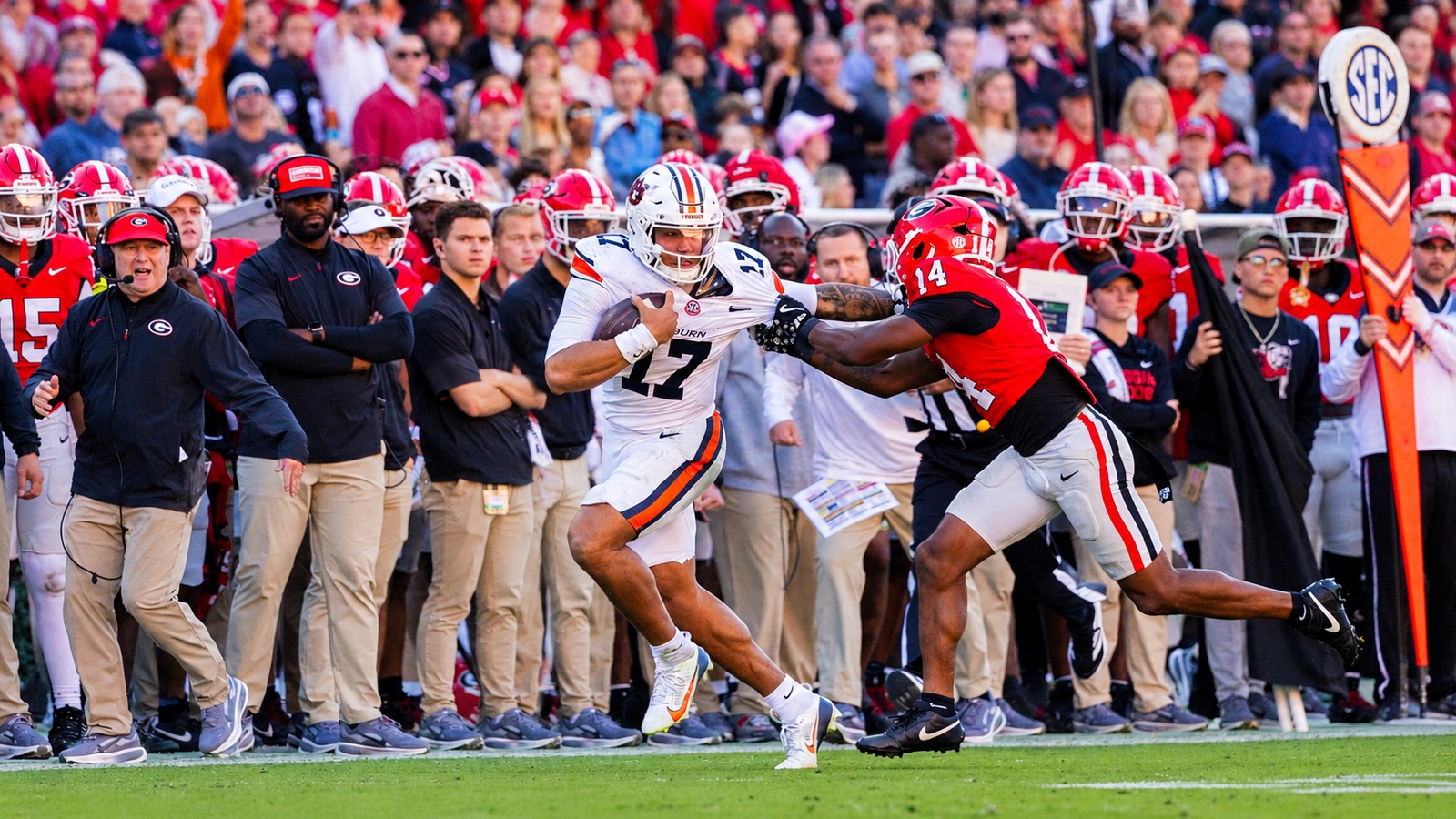
The Tigers walked into Sanford Stadium as an unranked underdog facing the No. 1 team in America. They walked out with a stunning 27–24 victory, handing Georgia a devastating defeat on its home turf.
And they did it the hard way.
Georgia jumped ahead 14–0, appearing ready to turn the afternoon into another routine victory. But Auburn refused to disappear. The Tigers responded with 24 unanswered points, transforming a seemingly predictable matchup into one of the season's biggest upsets.
Even after Georgia rallied to tie the game late, Auburn found one final opportunity. A costly Gunner Stockton fumble gave the Tigers new life, and kicker Alex McPherson delivered the winning 34-yard field goal.
It was Auburn's first victory in Athens in 31 years and snapped a 93-game home winning streak for AP No. 1 teams facing unranked opponents.
Think about that.
For more than three decades, Auburn had failed to accomplish what it did Saturday. Yet on a weekend defined by the unexpected, the Tigers produced the kind of victory that can change the direction of an entire season.
For Georgia, the questions begin immediately.
Was this simply a bad afternoon filled with costly mistakes? Or did Auburn expose weaknesses that future opponents will now attempt to exploit?
Georgia remains talented enough to compete with almost anyone in the country. One defeat doesn't erase that. But the Bulldogs no longer have the luxury of looking untouchable.
And Auburn?
The Tigers just reminded everyone that a disappointing record doesn't necessarily make a team incapable of greatness on a given Saturday.
That's the beauty and cruelty of college football.
BYU Isn't Asking for Respect Anymore. It's Demanding It.

For years, the conversation surrounding college football's national championship contenders has revolved around the same familiar names.
Georgia. Alabama. Ohio State. Notre Dame.
BYU has apparently decided it's time to crash the party.
On Saturday night in Provo, the Cougars defeated Notre Dame 28–24 in the first AP top-10 matchup ever hosted at LaVell Edwards Stadium. It wasn't just another ranked victory. It was the kind of statement that forces the entire country to reconsider what it thought it knew about a program.
Even without standout running back LJ Martin, BYU found a way to beat one of the nation's most recognizable football brands. The victory pushed the Cougars to 6–0 and elevated them to No. 2 in the latest AP poll — their highest ranking since their national championship season in 1984.
And perhaps that's what makes this season so fascinating.
Why shouldn't BYU be considered a legitimate national championship contender?
Why should a program's historical reputation matter more than what it's accomplishing on the field right now?
Notre Dame entered Saturday with national championship aspirations and departed with its first loss of the season. BYU entered with an opportunity to validate its unbeaten record and delivered when the spotlight was brightest.
The Cougars aren't benefiting from some hypothetical argument about what they might accomplish against elite competition.
They just beat it.
Of course, winning in October is different from winning in December and January. The pressure increases, the competition improves, and the margin for error becomes increasingly unforgiving.
But at some point, results have to outweigh reputation.
BYU has earned the right to be included in the national championship conversation.
And anyone still dismissing the Cougars simply because of the name on their jerseys might want to reconsider.
Tennessee Doesn't Just Beat Alabama. It Exposes a Bigger Problem.

There was a time when Alabama losing a football game felt like a national emergency.
Now, the Crimson Tide have lost two in a row.
Tennessee's 26–10 victory over Alabama wasn't some miraculous last-second escape. It was a convincing performance against a program that has spent much of the past two decades setting the standard for college football.
The Volunteers held Alabama to just 93 total yards in the first half, establishing a defensive tone that the Crimson Tide struggled to overcome. Tennessee eventually pulled away, leaving Alabama with its second consecutive defeat and serious questions about its championship credentials.
This wasn't the Alabama performance generations of college football fans have come to expect.
And that's where the conversation becomes interesting.
Are we witnessing a temporary stumble by a talented program, or the continuing erosion of the aura of invincibility that surrounded Alabama for so many years?
The Crimson Tide are still capable of competing with elite opponents. The roster hasn't suddenly forgotten how to play football. But the days when Alabama could intimidate opponents simply by stepping onto the field appear increasingly distant.
Tennessee didn't play like a team afraid of Alabama.
It played like a team that believed it was better.
And on Saturday, it was.
For the Volunteers, the victory strengthens their position in the SEC championship and playoff races. For Alabama, now sitting at 5–2 and ranked No. 13, the remainder of the season carries significantly more pressure.
Another defeat could make an already difficult playoff argument even harder to defend.
The Alabama brand remains powerful.
But brands don't win football games.
Players do.
The College Football Playoff Race Is Becoming Beautifully Unpredictable
Perhaps no part of Saturday's madness carries greater consequences than the College Football Playoff picture.
Consider where the country stood entering the weekend.
Georgia was No. 1. Notre Dame was No. 2. Alabama and Texas were firmly established among the nation's highest-ranked contenders.
Forty-eight hours later, the entire conversation had changed.
Miami emerged as the new No. 1 team after surviving Florida State 43–35 in double overtime. BYU climbed to No. 2. Ohio State moved to No. 3 after defeating Indiana 19–15. Meanwhile, Georgia fell to No. 5, Alabama dropped to No. 13, and Texas plummeted to No. 19.
And those changes might only be the beginning.
Miami is undefeated, but its narrow escape against Florida State demonstrated that even the nation's top-ranked team has vulnerabilities. BYU is undefeated, but now faces the challenge of maintaining its momentum with a target on its back.
Texas Tech, Utah and UCLA are also undefeated, each with an opportunity to build a résumé capable of competing with the sport's established powers.
Meanwhile, traditional heavyweights are finding themselves in unfamiliar territory.
Georgia must respond to adversity. Notre Dame must prove its loss to BYU won't define its season. Alabama no longer has much room for another mistake. Texas faces an uphill climb after its second defeat.
The debate over which teams deserve playoff consideration is only going to intensify.
And that's exactly how it should be.
For too long, much of the college football conversation has been dominated by assumptions about which programs belong in championship contention before the season even begins.
This year, the sport seems determined to challenge every one of those assumptions.
A playoff race featuring Miami, BYU, Ohio State, Georgia, Texas Tech, Utah, Tennessee and several other legitimate contenders is far more intriguing than one in which the same familiar programs cruise toward December without meaningful resistance.
The beauty of an expanded playoff isn't simply that more teams get an opportunity.
It's that more teams have something meaningful to play for when the season reaches its most important stretch.
And after Saturday, there's no shortage of teams still fighting for that opportunity.
Has College Football Finally Entered an Era of True Parity?
There's a larger question emerging from all this chaos, one that extends well beyond a single Saturday.
Is the gap between college football's traditional powerhouses and the rest of the country finally beginning to close?
The transfer portal, NIL opportunities and revenue-sharing arrangements have fundamentally changed how programs build and maintain competitive rosters.
Elite players have more freedom to move. Programs have more ways to attract talent. And coaches face the increasingly difficult task of assembling teams capable of competing immediately rather than developing players over several seasons.
None of that guarantees competitive balance.
The richest and most established programs still possess enormous advantages in resources, recruiting infrastructure and national exposure.
But the results suggest that those advantages aren't always enough.
Auburn went into Athens and beat Georgia. Tennessee controlled Alabama. BYU defeated Notre Dame. Florida traveled to Austin and stunned Texas.
These weren't hypothetical arguments about parity.
They were results.
And they raise a fascinating possibility: What if college football is becoming a sport where the difference between the nation's best teams and everybody else is smaller than we've been conditioned to believe?
That doesn't mean the Georgia and Alabama dynasties of the past were somehow less impressive. If anything, it makes their sustained dominance look even more remarkable.
But the sport is changing.
And perhaps the biggest winners are the fans.
Because unpredictability is what makes college football different.
It's what turns an ordinary October afternoon into a memory that lives for decades. It's what sends thousands of fans streaming onto fields, gives overlooked programs their defining moments, and leaves entire fan bases questioning everything they thought they understood about their teams.
It's what makes the sport impossible to predict and even harder to stop watching.
And the Scariest Part? We're Just Getting Started.
We haven't reached November.
Conference championship races remain unsettled.
The first official College Football Playoff rankings haven't even arrived.
And yet, the 2026 season has already produced enough chaos to fill an entire year's worth of highlights.
Maybe Georgia responds by winning out. Maybe Alabama rediscovers its championship identity. Maybe Notre Dame turns Saturday's disappointment into the motivation for a late-season run.
Or maybe BYU, Miami or another emerging contender writes a completely different ending.
That's the point.
Nobody knows.
Not the analysts. Not the coaches. Not the fans who spend every offseason convincing themselves they have the national championship picture figured out.
And after what happened Saturday, anyone claiming to know exactly how this season will unfold is probably setting themselves up for disappointment.
Because the most important lesson from Week 7 wasn't that Georgia is vulnerable, Alabama is struggling or BYU deserves respect.
It was something much simpler.
There are no guarantees in college football anymore.
Every ranking can be challenged. Every favorite can fall. Every championship dream can change with one turnover, one fourth-down stop or one perfectly placed field goal.
And somewhere across the country, another overlooked program is preparing for an opportunity to become the next headline.
That's why we watch.
That's why millions of fans sacrifice their Saturdays, ride the emotional roller coaster of every possession and come back the following week regardless of how much their team disappointed them.
Because college football doesn't follow a script.
It never has.
And if Week 7 taught us anything, it's that the 2026 season has no intention of becoming predictable anytime soon.
College football has officially lost its mind.
And we're only in October.