

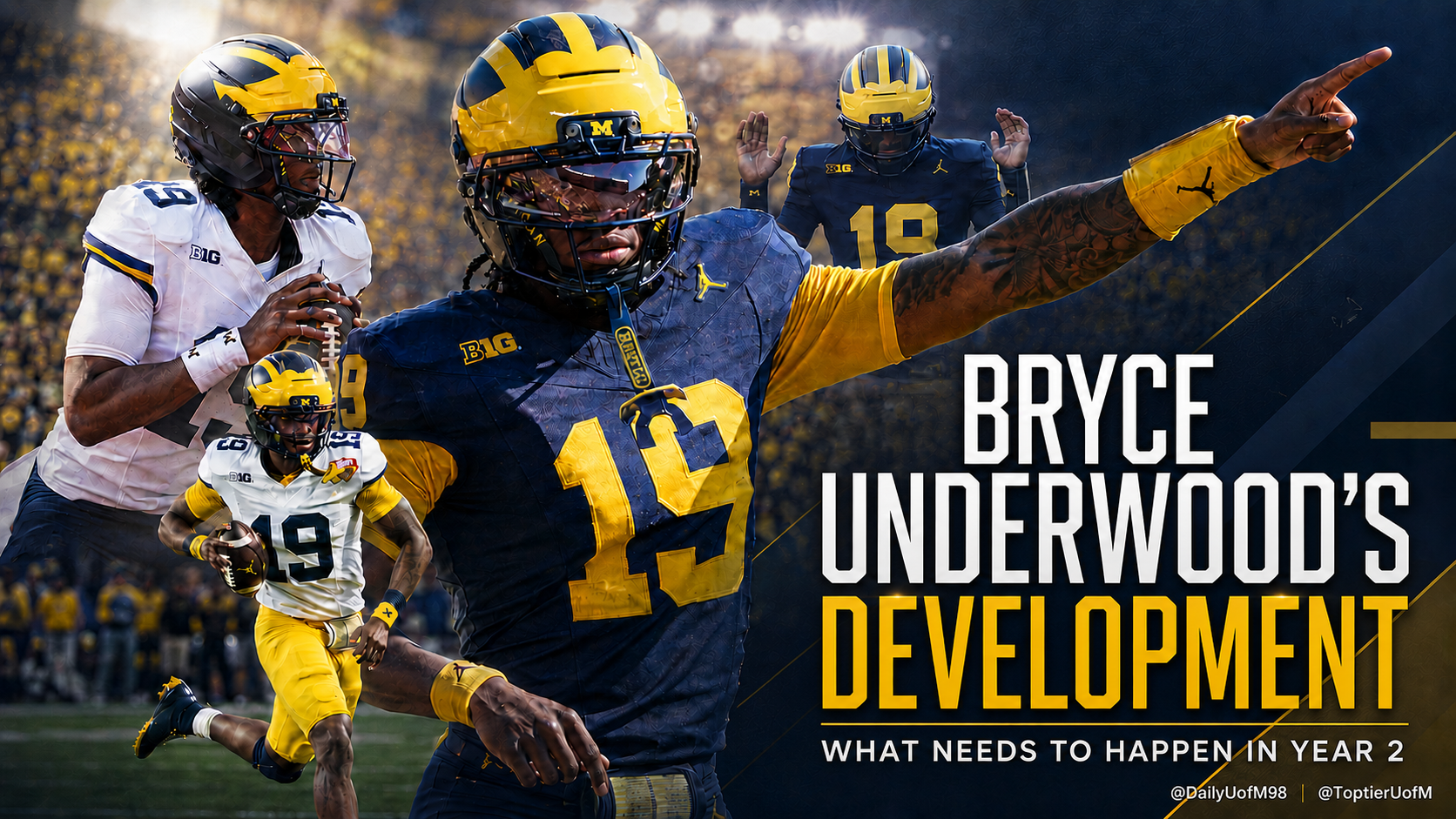
Bryce Underwood’s Development—and What Needs to Happen in Year 2
As the season approaches, expectations continue to rise for Michigan quarterback Bryce Underwood.
Some would love to see him contend for the Heisman Trophy, earn All-America honors, win a Big Ten championship and lead Michigan back to the College Football Playoff. Those are lofty expectations for any quarterback—even one who arrived in Ann Arbor as the nation’s No. 1 overall recruit.
But before Underwood can begin collecting awards or competing for championships, everything must start with his leadership.
Underwood enters his sophomore season after being voted a team captain, an honor held by only a select group of players on Michigan’s roster. With that title comes the responsibility of becoming one of the program’s most important leaders.
His demeanor has already changed considerably since his freshman year. Some people viewed his confidence as cockiness or overconfidence when he first arrived. Now, he appears calm, cool and collected, while still carrying the confidence required to play quarterback at Michigan.
After enduring a difficult freshman season, that maturity represents an important step forward. As the year progresses, Underwood must continue growing into that leadership role and help bring an explosiveness to Michigan’s offense that it has lacked for quite some time.
What Underwood Must Accomplish in Year 2
My expectations for Underwood’s second season are relatively simple: make plays, limit turnovers and use his legs intelligently.
His touch as a passer was inconsistent last season. On one play, he could deliver a smooth, well-placed ball that gave his receiver an opportunity to make a play. On the next, he might fire a pass with so much velocity that it became difficult to handle.
Based on what we have seen during camp, drills and scrimmages, Underwood’s touch has improved significantly. He also appears much more comfortable operating from the pocket.
His ability to throw on the run continues to develop as well. That was something Underwood enjoyed doing last season, and I expect head coach Kyle Whittingham and offensive coordinator Jason Beck to make it a major part of Michigan’s offense. Underwood’s athleticism gives the coaching staff opportunities to move the pocket, change throwing angles and put additional pressure on opposing defenses.
Improving His RPO Decision-Making
One of Underwood’s biggest struggles last season was reading run-pass options.
Too often, he appeared unable to process the defense quickly enough to make the correct decision. Receivers would come open, but the ball arrived too late. Other plays ended with Underwood taking off unnecessarily, losing yardage or committing a turnover.
Based on the available film and reports from Michigan’s scrimmages, this appears to be another area in which Underwood has taken a significant step forward.
That improvement could move Michigan’s offense closer to becoming truly dangerous. Underwood’s arm strength, mobility and playmaking ability make him an ideal fit for an RPO-heavy system. If he consistently makes the correct reads, I expect Michigan to feature those concepts much more frequently this season.
Why His Footwork Matters
Underwood’s footwork has been one of the biggest topics surrounding his development this offseason—and it is more important than many people realize.
His footwork was inconsistent throughout his freshman season. It is also important to remember that he did not have a dedicated quarterbacks coach and was essentially forced to figure out portions of his development on his own.
With the help of Coach Detmer and Beck, Underwood’s movements now appear considerably more natural. Proper footwork must eventually become automatic. A quarterback cannot afford to think about every step while simultaneously reading the defense, navigating pressure and delivering an accurate pass.
Underwood appears to be reaching that point.
Improved footwork should also strengthen his pocket presence. Last season, he occasionally panicked when pressure arrived. Panic in the pocket can lead to costly turnovers, negative plays and missed scoring opportunities. It can also provide the opposing offense with excellent field position.
At 6-foot-4 with impressive strength and athleticism, Underwood has the physical tools to remain poised and make plays under pressure. If his improved pocket presence carries into the season, it will completely change the way he plays—and the level of confidence he brings to every part of the field.
Unlocking Underwood’s Running Ability
Using Underwood’s legs will also be crucial to Michigan’s success.
Last season, we saw several moments when he escaped the pocket and gained significant yardage simply by trusting his instincts and reacting to the defense.
Now, Whittingham and Beck have an opportunity to turn that natural ability into a structured part of the offense. After watching how they utilized Devon Dampier’s mobility at Utah, imagine what they can design for a 6-foot-4 sophomore who runs with tremendous power and athleticism.
Designed quarterback runs and scrambles could elevate Michigan’s offense to the level it hoped to reach with JJ McCarthy. The key will be finding the proper balance—allowing Underwood to use his athleticism without exposing him to unnecessary hits.
Developing His Touch on the Deep Ball
The final area to watch is Underwood’s touch, particularly on deep passes.
Michigan desperately needed more explosive plays last season. Too often, its attempts to stretch the field felt like prayers rather than calculated opportunities. Even when a receiver made the catch, the placement of the ball rarely allowed him to continue running and create additional yardage.
Underwood should have better weapons on the outside this season—receivers capable of creating separation and threatening defenses vertically. His responsibility will be placing the ball directly into the “breadbasket,” giving those playmakers opportunities to catch it in stride and create huge gains.
If Underwood can consistently connect on those throws, he could bring an element to Michigan’s offense that it has rarely featured over the past two decades.
My Statistical Benchmark for a Successful Season
Here is what I believe Underwood must produce for his second season to be considered successful:
- 3,000 passing yards
- 25 passing touchdowns
- Seven to nine interceptions
- 750 rushing yards
- Five to seven rushing touchdowns
If Underwood reaches those numbers, limits his mistakes and continues developing as a leader, Michigan should be positioned for a highly successful season.
The physical ability has never been the question. Year 2 will be about turning that potential into consistent production—and proving that Underwood is ready to lead Michigan back into championship contention.
Go Blue.