

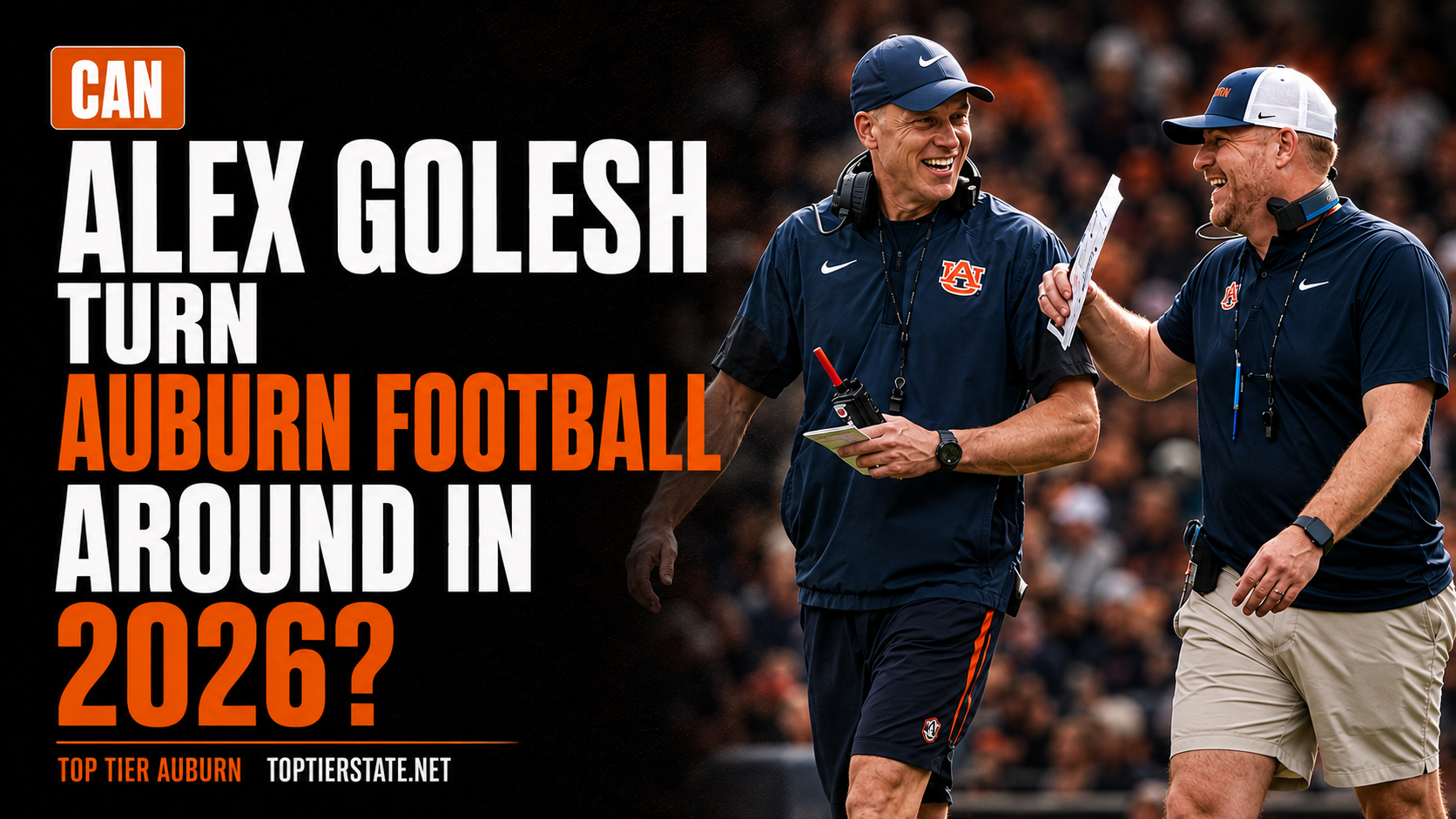
Alex Golesh enters the 2026 college football season facing one of the biggest challenges of his coaching career: turning Auburn football back into a winner.
The Tigers haven’t posted a winning season since 2020. They haven’t won eight games since 2019. And after five consecutive losing seasons, Auburn is betting that Golesh’s offensive success at Tennessee and USF can finally end one of the longest slumps in the program’s modern history.
For most college football programs, six years without an eight-win season would be disappointing.
At Auburn, it feels almost unthinkable.
This is a program that won a national championship in 2010, played for another in 2013 and reached the SEC Championship Game as recently as 2017. Auburn built its modern identity around competing with the giants of college football, often while navigating one of the most difficult schedules in the country.
Yet as Golesh prepares for his first season on the Plains, Auburn finds itself confronting a reality few would have predicted at the end of the 2010s.
The Tigers went 6-5 during the pandemic-shortened 2020 season. Since then, Auburn has finished 6-7, 5-7, 6-7, 5-7 and 5-7.
That’s five consecutive losing seasons and only 27 victories during that stretch.
For a program with Auburn’s resources, recruiting footprint, fan base and history, that isn’t supposed to happen.
Now Golesh has been handed the responsibility of ending it.
And there are legitimate reasons to believe Auburn may have hired the right coach at the right time.
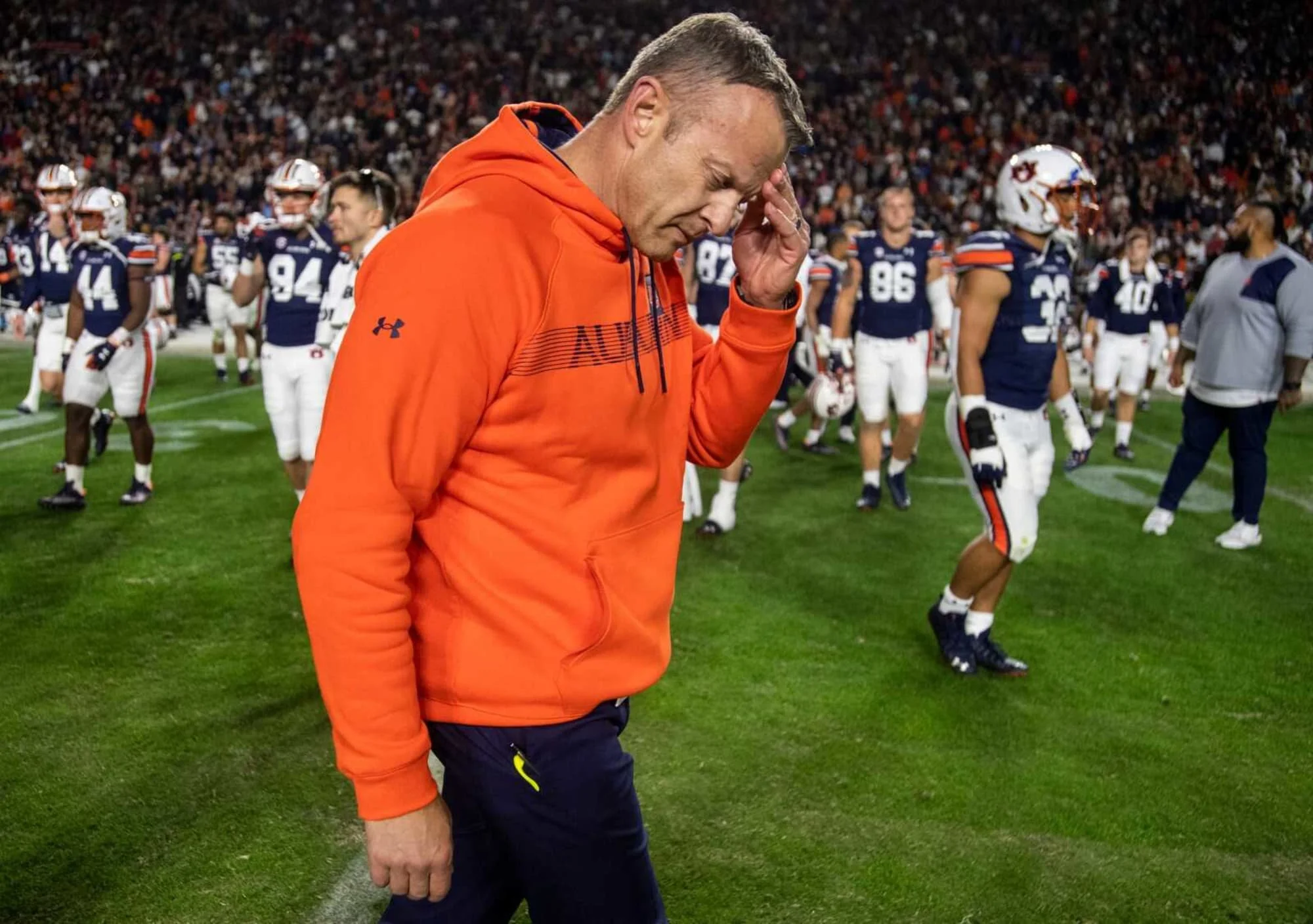
Why Auburn Football Has Struggled Since 2020
The most frustrating part of Auburn’s decline hasn’t been one catastrophic season.
It’s been the repetition.
2021: 6-7
2022: 5-7
2023: 6-7
2024: 5-7
2025: 5-7
Auburn has repeatedly been close enough to create optimism but never good enough to turn that optimism into meaningful progress.
There have been coaching changes, quarterback changes, transfer-portal additions and highly rated recruiting classes.
The breakthrough never came.
Auburn’s last eight-win season came in 2019, when Gus Malzahn’s Tigers finished 9-4 and defeated Alabama 48-45 in one of the most memorable Iron Bowls in recent history. That Auburn team also defeated Oregon and Texas A&M before finishing No. 14 in the final AP poll.
Since then, Auburn has been searching for its way back.
Malzahn was fired following the 2020 season. Bryan Harsin lasted less than two full seasons. Hugh Freeze arrived with expectations of restoring Auburn through recruiting and offensive development, but the results never materialized.
The 2025 season became another painful chapter.
Auburn started 3-0 before losing six of its next seven games. The Tigers finished just 1-7 in SEC play, with conference losses to Oklahoma, Texas A&M, Georgia, Missouri, Kentucky, Vanderbilt and Alabama.
There were competitive losses. There were games Auburn could have won.
But eventually, competitive losses stop being encouraging.
At Auburn, you’re expected to win those games.
That’s the environment Golesh inherited.
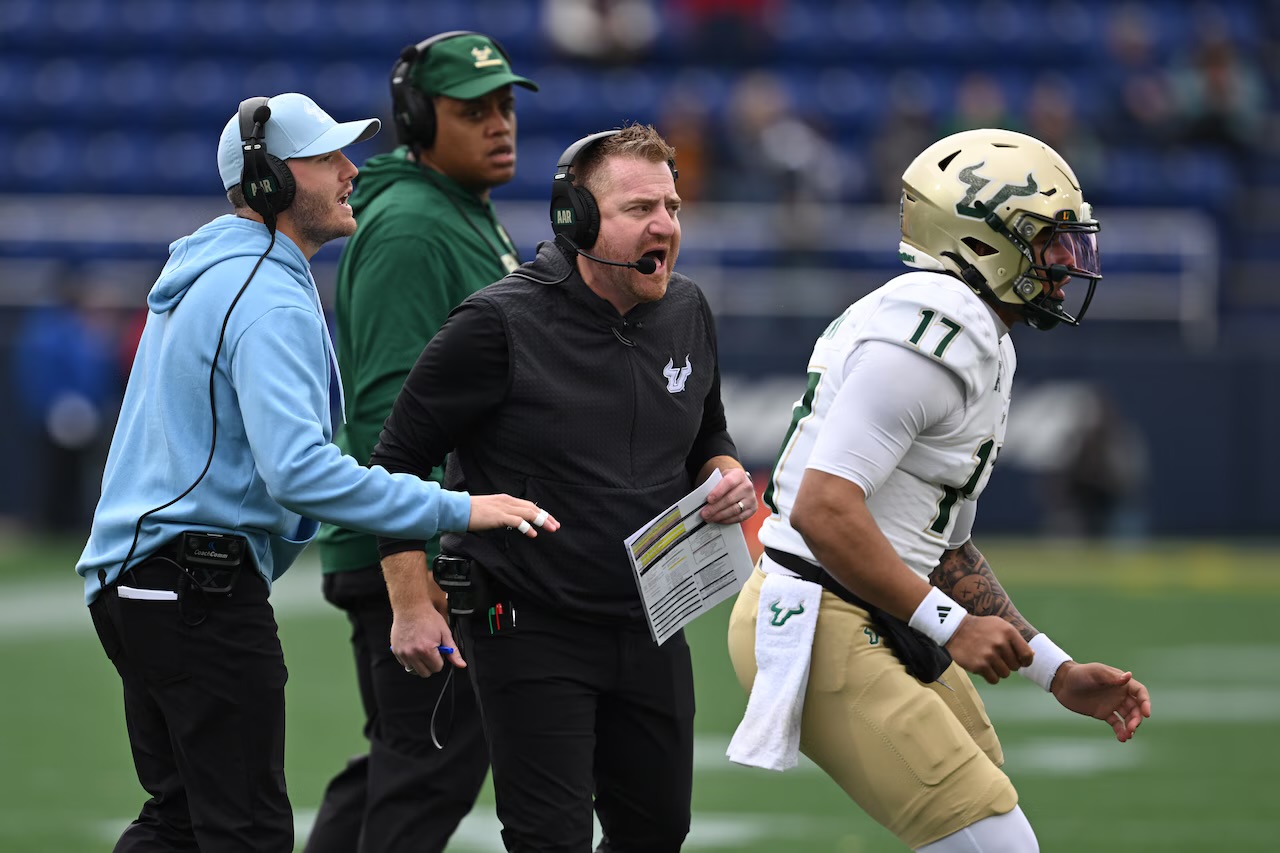
How Alex Golesh Turned Around USF Football
Golesh isn’t arriving at Auburn with a résumé built entirely on potential.
He’s already rebuilt a struggling college football program.
Before Golesh took over at South Florida in 2023, the Bulls had won only four games over the previous three seasons.
Four wins in three years.
Golesh immediately began changing the trajectory of the program.
USF reached bowl eligibility in each of his three seasons and won 23 games during his tenure. The Bulls won bowl games following the 2023 and 2024 seasons before taking another significant step forward in 2025.
USF finished the 2025 regular season 9-3, returned to the AP Top 25 for the first time since 2018 and opened the season with consecutive victories over ranked Boise State and Florida teams.
He didn’t inherit a machine.
He helped build one.
That’s important when evaluating whether Golesh can succeed at Auburn.
Auburn doesn’t need a coach capable of maintaining success.
It needs someone capable of creating it again.
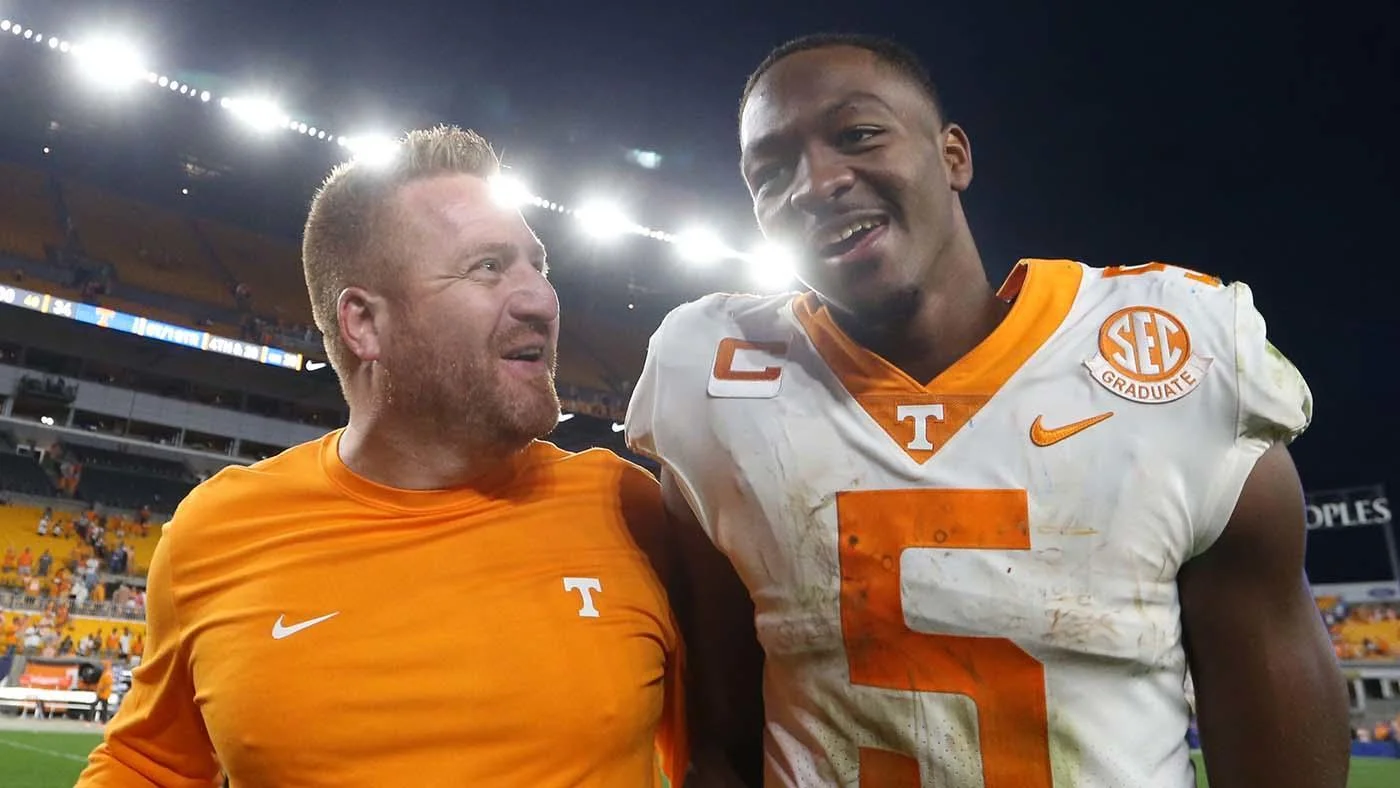
Alex Golesh’s Offense Transformed Tennessee
Golesh’s reputation as one of college football’s most respected offensive minds began well before his time at USF.
His calling card has always been offense.
And his two seasons as Tennessee’s offensive coordinator remain perhaps the best evidence of what Auburn could eventually become.
Golesh joined Josh Heupel’s Tennessee staff in 2021 after the Volunteers had gone just 3-7 the previous season.
The transformation was immediate.
Tennessee’s scoring offense jumped from 108th nationally in 2020 to seventh in 2021, averaging 39.3 points per game.
Then came 2022.
Tennessee went 11-2 and produced one of the most explosive offenses in college football.
The Volunteers averaged 46.1 points and 525.5 yards per game, accumulated 6,832 yards of offense and scored 79 offensive touchdowns.
Quarterback Hendon Hooker threw for 3,135 yards and 27 touchdowns while emerging as a legitimate Heisman Trophy contender before suffering a season-ending injury.
For much of that season, Tennessee had arguably the most dangerous offense in America.
The Volunteers scored 38 against Florida.
They scored 40 at LSU.
They scored 52 against Alabama in an unforgettable victory in Knoxville.
They put 44 on Kentucky and 66 on Missouri.
Tennessee wasn’t simply winning.
It was overwhelming teams offensively.
Golesh’s work earned him a Broyles Award nomination as one of the nation’s top assistant coaches.
That’s the offensive identity Auburn hopes he can recreate on the Plains.
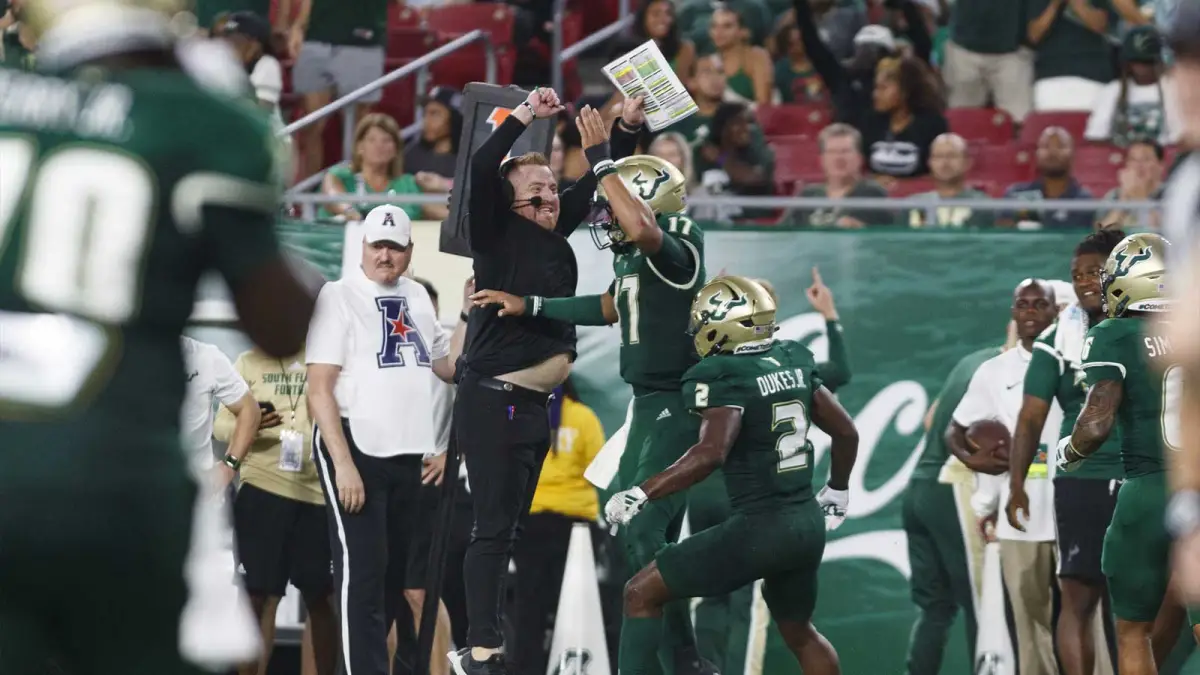
Golesh Proved His Offense Could Work Without Tennessee
When Golesh left Knoxville to become USF’s head coach, there was an obvious question.
How much of Tennessee’s offensive success belonged to Golesh?
After all, Heupel was an established offensive coach himself. Tennessee had SEC talent, Hooker at quarterback and future NFL players throughout the roster.
Golesh’s three seasons at USF provided a convincing answer.
The offense followed him.
USF averaged more than 35 points and 450 yards per game during his tenure.
By 2025, the Bulls had become one of the most productive offenses in college football, finishing the regular season No. 2 nationally in total offense at 501.7 yards per game and No. 5 in scoring offense at 43 points per game.
Different program.
Different conference.
Different roster.
Same result.
Golesh created offense.
Now comes the biggest test of his career.
Can he do it in the SEC?

Byrum Brown Could Accelerate Auburn’s Rebuild
Golesh won’t have to start completely from scratch.
That’s because one of the most important players from his USF offense followed him to Auburn.
Byrum Brown gives Auburn a quarterback who already knows exactly what Golesh wants to do offensively.
Brown developed into one of college football’s most productive dual-threat quarterbacks at USF. In 2025, he threw for more than 3,000 yards while rushing for more than 1,000, becoming just the 12th player in FBS history to reach both marks in the same season.
That familiarity could be enormously important.
New coaches frequently spend their first season teaching quarterbacks terminology, reads, protections and the fundamental structure of a new offense.
Golesh doesn’t have that problem with Brown.
His quarterback has already operated the system.
He has already succeeded in it.
And he understands the tempo and decision-making required to make it work.
That doesn’t guarantee Brown’s production will immediately translate to the SEC.
But it could significantly shorten Auburn’s learning curve.
Auburn Desperately Needs an Offensive Identity
Auburn hasn’t simply struggled to win games over the last several years.
The Tigers have struggled to establish an offensive identity.
There have been different quarterbacks, coordinators and systems without enough sustained success to establish continuity.
Golesh changes that.
Auburn’s head coach is now the architect of the offense.
The Tigers aren’t hiring a CEO-style head coach and hoping he chooses the right offensive coordinator.
This is Golesh’s system.
His philosophy.
His responsibility.
And Auburn has aggressively reshaped its 2026 roster around that philosophy.
Brown isn’t the only player who followed Golesh from Tampa. Auburn also added multiple transfers familiar with his system while using the portal to overhaul significant portions of the roster.
Instead of spending the entire 2026 season laying the foundation for an offense that might eventually work, Golesh has brought pieces with him that already know how it’s supposed to operate.
That’s a luxury most first-year SEC coaches don’t have.
Auburn’s 2026 Schedule Will Test Golesh Immediately
There is, however, an enormous difference between rebuilding South Florida and rebuilding Auburn.
The SEC doesn’t provide many weeks to figure things out.
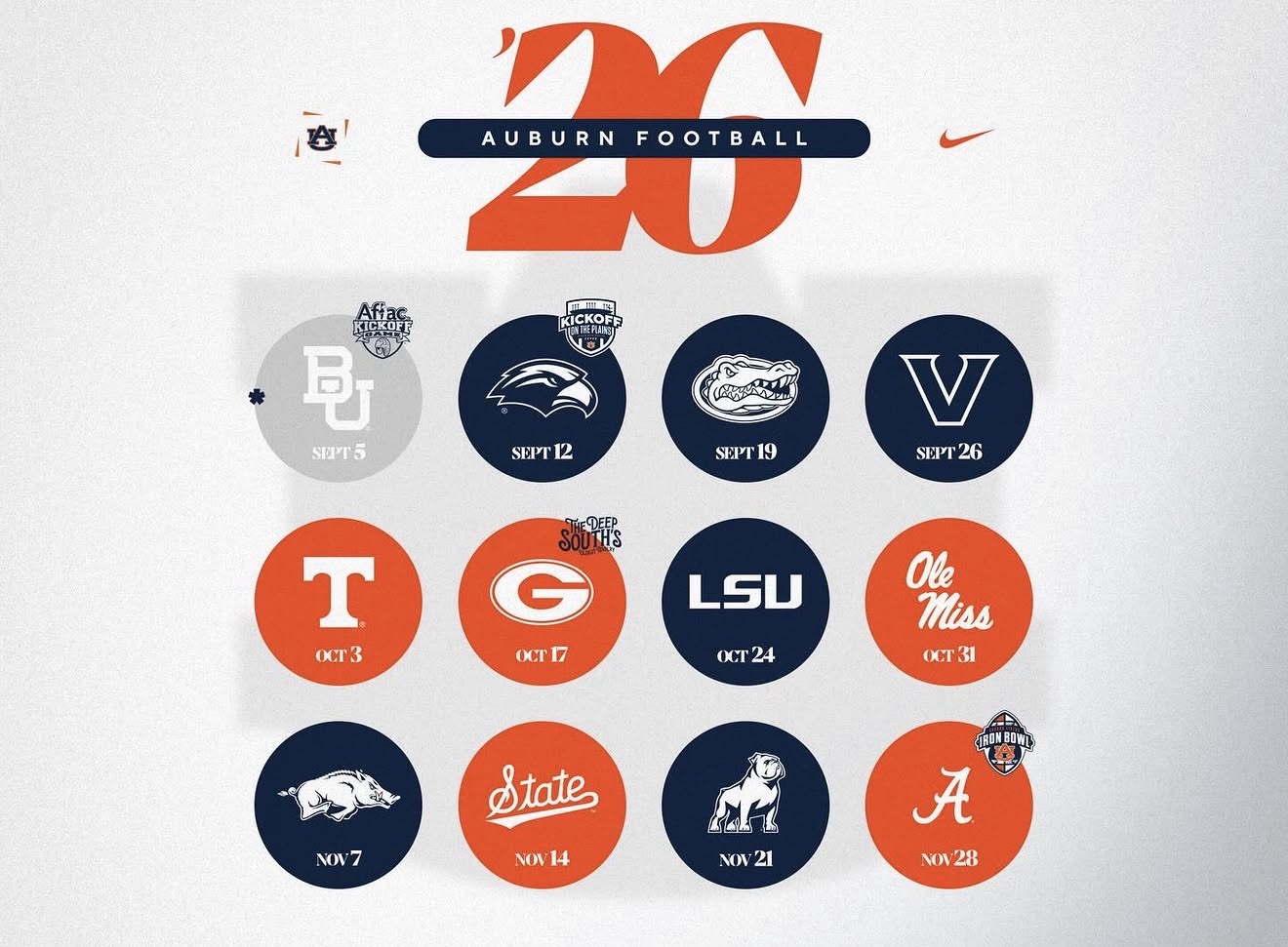
Auburn’s 2026 football schedule includes road games against Tennessee, Georgia, Ole Miss and Alabama, while Florida and LSU travel to Jordan-Hare Stadium.
That’s a serious test for any program, much less one introducing a new head coach and offensive system.
Golesh will regularly face defensive lines filled with future NFL players. The windows will become smaller. Defenders will become faster. Mistakes that USF could survive against lesser competition could decide games in the SEC.
Auburn doesn’t necessarily need Golesh to produce 43 points and 500 yards per game.
It needs his offense to become good enough to win SEC games.
That’s an important distinction.
If Auburn’s defense can keep the Tigers competitive, Golesh doesn’t have to create Tennessee’s 2022 offense overnight.
He simply has to make Auburn substantially more dangerous than it has been.
Golesh Has Already Helped Rebuild an SEC Power
There is another reason Auburn fans can find optimism in Golesh’s résumé.
He’s seen this type of rebuild before.
Before Heupel and Golesh arrived in Knoxville, Tennessee had endured years of instability that should sound familiar to Auburn fans.
The Volunteers went 4-8 in 2017.
They went 5-7 in 2018.
They improved to 8-5 in 2019 before collapsing to 3-7 in 2020.
Then Heupel and Golesh arrived.
Tennessee improved to 7-6 in Year 1.
Then 11-2 in Year 2.
By October 2022, Tennessee wasn’t talking about rebuilding anymore.
The Volunteers were beating Alabama and competing for a College Football Playoff berth.
Golesh witnessed firsthand how quickly the trajectory of an SEC program can change when quarterback development, offensive identity, recruiting and confidence come together.
Now he has to prove he can oversee that transformation himself.
Auburn Doesn’t Need a Five-Year Rebuild
Perhaps that’s what makes the Golesh era so intriguing.
Auburn shouldn’t need five years to become competitive again.
This isn’t a program without resources.
Jordan-Hare Stadium remains one of college football’s great home environments. Auburn sold out its public season-ticket allotment for the fourth consecutive season entering 2026 despite five consecutive losing seasons.
The fan base hasn’t disappeared.
The expectations haven’t disappeared.
The recruiting territory hasn’t disappeared.
The resources haven’t disappeared.
The winning has.
Golesh’s job is to reconnect those pieces.
Nobody should reasonably expect Auburn to immediately transform into the program that went 14-0 behind Cam Newton in 2010 or came within seconds of another national championship in 2013.
But expecting Auburn to eventually win eight or nine games shouldn’t be considered unrealistic.
For much of the program’s history, that was the expectation.
Now it would represent significant progress.
Can Alex Golesh Turn Auburn Football Around in 2026?
The answer will ultimately depend on whether Golesh’s offensive success translates to SEC competition.
There are reasons for optimism.
Golesh helped engineer one of the greatest offensive turnarounds in recent Tennessee football history. He then inherited a USF program that had won four games in three seasons and produced 23 victories during his three-year tenure.
His final USF offense finished second nationally in total offense.
He has a proven system.
He has a quarterback who already knows it.
And he’s taking over a program that, despite everything that has happened over the last six seasons, still possesses the resources to win at a high level.
There are no guarantees.
Golesh has never coached a game as an SEC head coach. He’s inheriting a program that has cycled through coaches and endured five consecutive losing seasons. He’s entering a conference where virtually every opponent has money, talent and expectations of its own.
But Auburn doesn’t need Golesh to perform a miracle.
It needs him to give the program an identity again.
It needs Saturdays in Jordan-Hare Stadium to feel dangerous again.
It needs November games to matter again.
And it needs to stop measuring progress by recruiting rankings, close losses and offseason optimism.
Eventually, progress has to be measured in wins.
Six years is a long time for Auburn football to wander.
The Tigers haven’t posted a winning season since 2020. They haven’t won eight games since 2019. They haven’t seriously competed for an SEC championship since 2017.
Alex Golesh was hired to change that.
And if the offensive success that followed him from Tennessee to South Florida follows him to Auburn, the Tigers’ return to relevance could come sooner than most expect.